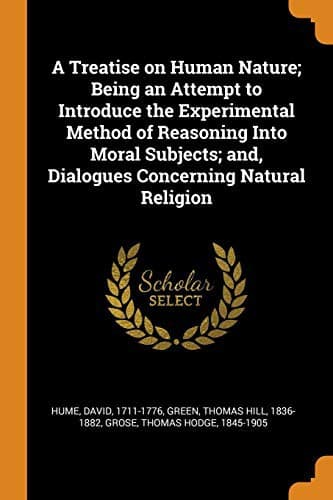
A Treatise of Human Nature: Being an Attempt to Introduce the Experimental Method Into Moral Subjects; and Dialogues Concerning Natural ReligionHume, David
PhilosophyPhilosophy
A Treatise of Human Nature: Being an Attempt to Introduce the Experimental Method Into Moral Subjects; and Dialogues Concerning Natural Religion
Hume, David
Emotions; Ethics; Knowledge, Theory of; Philosophy, English
309. That it is gratuitous we may readily admit, but only because a
recognition of the function of the Ego in the primary constitution
of the qualified individual object--this pen or this paper--renders
it superfluous. To the philosophy, however, in which Hume was
bred, the perception of a qualified object was simply a feeling.
No intellectual synthesis of successive feelings was recognized as
involved in it. It was only so far as the dependence of the feeling
on our organs, in the absence of any clear distinction between
feeling and felt thing, seemed to imply a dependent and broken
existence of the thing, that any difficulty arose--a difficulty met
by the supposition that the felt thing, whose existence was thus
broken and dependent, represented an unfelt and permanent thing of
which it is a copy or effect. To the Berkeleian objections, already
fatal to this supposition, Hume has his own to add, viz. that we can
have no idea of relation in the way of cause and effect except as
between objects which we have observed, and therefore can have no
idea of it as existing between a perception and an object of which
we can only say that it is not a perception. Is all existence then
‘broken and dependent’? That is the ‘sceptical’ conclusion which
Hume professes to adopt--subject, however, to the condition of
accounting for the contrary supposition (without which, as he has to
admit, we could not think or speak, and which alone gives a meaning
to his own phraseology about impressions and ideas) as a fiction of
the imagination. He does this, as we have seen, by tracing a series
of contradictions, with corresponding hypotheses invented, either
instinctively or upon reflection, in order to escape the uneasiness
which they cause, all ultimately due to our mistaking similar
successive feelings for an identical object. Of such an object, then,
we must have an idea to begin with, and it is an object permanent
throughout a variation of time, which means a succession of feelings;
in other words, it is a felt thing, as distinct from feelings but to
which feelings are referred as its qualities. Thus the most primary
perception--that in default of which Hume would have no reality
to oppose to fiction, nor any point of departure for the supposed
construction of fictions--already implies that transformation of
feelings into changing relations of a thing which, preventing any
incompatibility between the perpetual brokenness of the feeling
and the permanence of the thing, ‘eludes’ by anticipation all the
contradictions which, according to Hume, we only ‘elude’ by speaking
as if we had ideas that we have not.
Yet they are not possible ideas, because copied from no impressions.
Public-domain text, read in full here on John Shaqi.
Reviews
Reviews
No reviews yet
Be the first to share your thoughts on this work.
Elsewhere in the archive
Join the Discussion
Join the discussion
Sign in to leave a comment or review.
Sign InorCreate an account