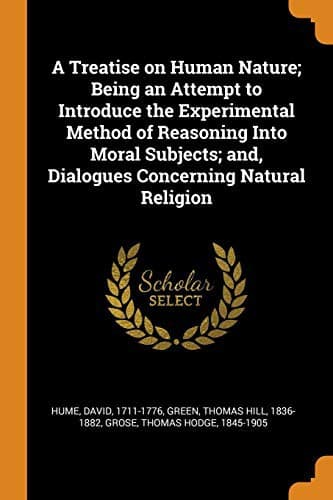
A Treatise of Human Nature: Being an Attempt to Introduce the Experimental Method Into Moral Subjects; and Dialogues Concerning Natural ReligionHume, David
PhilosophyPhilosophy
A Treatise of Human Nature: Being an Attempt to Introduce the Experimental Method Into Moral Subjects; and Dialogues Concerning Natural Religion
Hume, David
Emotions; Ethics; Knowledge, Theory of; Philosophy, English
315. The supposed difference then between immediate and mediate
cognition is no absolute difference. It is not a difference between
experience and a process that goes beyond experience, or between an
experience unregulated by a conception of a permanent system and
one that is so regulated. It lies merely in the degree of fullness
and articulation which that conception has attained. If this had
been what Hume meant to convey in his assimilation of inference to
perception, he would have gone far to anticipate the result of the
enquiry which Kant started. And this is what he might have come
to mean if, instead of playing fast and loose with ‘impression’
and ‘object,’ using each as plausibility required on the principle
of accommodation to the ‘vulgar,’ he had faced the consequence of
his own implicit admission, that every perception of an object as
identical is a ‘fiction’ in which we go beyond present feeling. As
it is, his ‘scepticism with regard to the senses’ goes far enough
to empty their ‘reports’ of the content which the ‘vulgar’ ascribe
to them, and thus to put a breach between sense and the processes
of knowledge, but not far enough to replace the ‘sensible thing’ by
a function of reason. In default of such replacement, there was no
way of filling the breach but to bring back the vulgar theory under
the cover of habits and ‘tendencies to feign,’ which all suppose a
ready-made knowledge of the sensible thing as their starting-point.
Hence the constant contradiction, which it is our thankless task
to trace, between his solution of the real world into a succession
of feelings and the devices by which he sought to make room in his
system for the actual procedure of the physical sciences. Conspicuous
among these is his allowance of that view of relation in the way of
cause and effect as an objective reality, which is represented by his
definition of it as a ‘philosophical relation.’ It is in the sense
represented by that definition that his doctrine has been understood
and retained by subsequent formulators of inductive logic; but on
examining it in the light of his own statements we have found that
the relation, as thus defined, is not that which his theory required,
and as which to represent it is the whole motive of his disquisition
on the subject. It is not a sequence of impression upon impression,
distinguished merely by its constancy; nor a sequence of idea upon
impression, distinguished merely by that transfer of liveliness to
the idea which arises from the constancy of its sequence upon the
impression. It is a relation between ‘objects’ of which each is what
it is only as ‘an instance of a species’ that exists continuously,
and therefore in distinction from our ‘perishing impressions,’
according to a regular order of ‘contiguity and succession.’ As
such existence and order are by Hume’s own showing no possible
impressions, and by consequence no possible ideas, so neither are the
‘objects’ which derive their whole character from them.
Public-domain text, read in full here on John Shaqi.
Reviews
Reviews
No reviews yet
Be the first to share your thoughts on this work.
Elsewhere in the archive
Join the Discussion
Join the discussion
Sign in to leave a comment or review.
Sign InorCreate an account