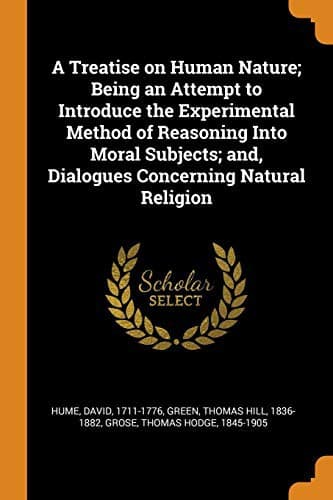
A Treatise of Human Nature: Being an Attempt to Introduce the Experimental Method Into Moral Subjects; and Dialogues Concerning Natural ReligionHume, David
PhilosophyPhilosophy
A Treatise of Human Nature: Being an Attempt to Introduce the Experimental Method Into Moral Subjects; and Dialogues Concerning Natural Religion
Hume, David
Emotions; Ethics; Knowledge, Theory of; Philosophy, English
314. Thus, though we may concede to Hume that neither in the
inference to the relation of cause and effect nor in the conclusions
we draw from it do we go ‘beyond experience,’ [1] this will merely
be, if his account of it as a ‘philosophical relation’ be true,
because in experience we already go beyond sense. ‘There is nothing,’
says Hume, ‘in any object considered in itself that can afford
us a reason for drawing a conclusion beyond it’ [2]--a statement
which to him means that, if the mind really passes from it to
another, this is only because as a matter of fact another feeling
follows on the first. But, in truth, if each feeling were merely
‘considered in itself,’ the fact that one follows on another would
be no fact _for the subject of the feelings_, no starting-point of
intelligent experience at all; for the fact is the relation between
the feelings--a relation which only exists for a subject that
considers neither feeling ‘in itself,’ as a ‘separate and perishing
existence,’ but finds a reality in the determination of each by the
other which, as it is not either or both of them, so survives, while
they pass, as a permanent factor of experience. Thus in order that
any definite ‘object’ of experience may exist for us, our feelings
must have ceased to be what according to Hume they are in themselves.
They cease to be so in virtue of the presence to them of the Ego,
in common relation to which they become related to each other as
mutually qualified members of a permanent system--a system which at
first for the individual consciousness exists only as a forecast
or in outline, and is gradually realized and filled up with the
accession of experience. It is quite true that nothing more than
the reference to such a system, already necessary to constitute the
simplest object of experience, is involved in that interpretation
of every event as a changed appearance of an unchanging order,
and therefore to be accounted for, which we call inference to a
cause or the inference of necessary connection; or, again, in the
identification of the event, the determination of its particular
nature by the discovery of its particular cause.
[1] Above, pars. 285 & 286.
[2] P. 436 and elsewhere. [Book I, part III., sec. XII.]
How his doctrine might have been developed. Its actual outcome.
Public-domain text, read in full here on John Shaqi.
Reviews
Reviews
No reviews yet
Be the first to share your thoughts on this work.
Elsewhere in the archive
Join the Discussion
Join the discussion
Sign in to leave a comment or review.
Sign InorCreate an account