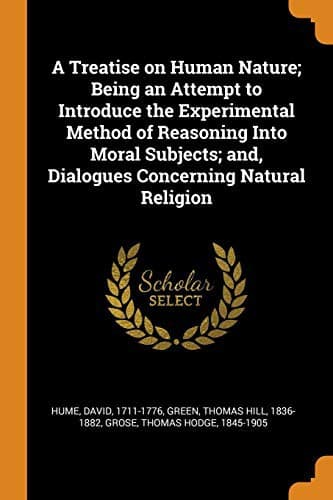
A Treatise of Human Nature: Being an Attempt to Introduce the Experimental Method Into Moral Subjects; and Dialogues Concerning Natural ReligionHume, David
PhilosophyPhilosophy
A Treatise of Human Nature: Being an Attempt to Introduce the Experimental Method Into Moral Subjects; and Dialogues Concerning Natural Religion
Hume, David
Emotions; Ethics; Knowledge, Theory of; Philosophy, English
indeed, as described, is already itself just the instinctive judgment
which has to be accounted for, and though this objection might be
met by a better statement, yet no statement could serve Locke’s
purpose which did not make assumption _(b)_ that sensations of light
and colour--‘simple ideas of secondary qualities’--are in the very
beginning of knowledge _appearances_, if not of _convex_ bodies, yet
of bodies; if not of bodies, yet of something which they reveal,
which remains there while they pass away.
The simple idea as ‘ectype’ other than mere sensation.
23. The same assumption is patent in Locke’s account of the
distinction between ‘real and fantastic,’ ‘adequate and inadequate,’
ideas. This distinction rests upon that between the thing as
archetype, and the idea as the corresponding ectype. Simple ideas he
holds to be necessarily ‘real’ and ‘adequate,’ because necessarily
answering to their archetypes. ‘Not that they are all of them images
or representations of what does exist: ... whiteness and coldness
are no more in snow than pain is: ... yet are they real ideas in
us, whereby we distinguish the qualities that are really in things
themselves. For these several appearances being designed to be the
marks whereby we are to know and distinguish things which we have
to do with, our ideas do as well serve us to that purpose, and are
as real distinguishing characters, whether they be only constant
effects, or else exact resemblances of something in the things
themselves.’ (Book II. chap. xxx. sec. 2.) The simple idea, then, is
a ‘mark’ or ‘distinguishing character,’ either as a copy or as an
effect, of something other than itself. Only as thus regarded, does
the distinction between real and fantastic possibly apply to it.
So too with the distinction between true and false ideas. As Locke
himself points out, the simple idea in itself is neither true nor
false. It can become so only as ‘referred to something extraneous
to it.’ (Book II. chap, xxxii. sec. 4.) For all that, he speaks of
simple ideas as true and necessarily true, because ‘being barely
such perceptions as God has fitted us to receive, and given power to
external objects to produce in us by established laws and ways ...
their truth consists in nothing else but in such appearances as are
produced in us, and must be suitable to those powers He has placed in
external objects, or else they could not be produced in us.’ (Book
II. chap, xxxii. sec. 14.) Here again we are brought to the same
point. The idea is an ‘appearance’ of something, necessarily true
when it cannot seem to be the appearance of anything else than that
of which it is the appearance. We thus come to the following dilemma.
Either the simple idea is referred to a thing, as its pattern or its
cause, or it cannot be regarded as either real or true. If it is
still objected that it need not be so referred in the beginning of
knowledge, though it comes to be so in the developed intelligence,
Public-domain text, read in full here on John Shaqi.
Reviews
Reviews
No reviews yet
Be the first to share your thoughts on this work.
Join the Discussion
Join the discussion
Sign in to leave a comment or review.
Sign InorCreate an account