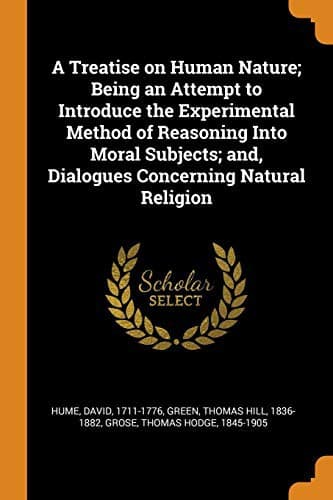
A Treatise of Human Nature: Being an Attempt to Introduce the Experimental Method Into Moral Subjects; and Dialogues Concerning Natural ReligionHume, David
PhilosophyPhilosophy
A Treatise of Human Nature: Being an Attempt to Introduce the Experimental Method Into Moral Subjects; and Dialogues Concerning Natural Religion
Hume, David
Emotions; Ethics; Knowledge, Theory of; Philosophy, English
9. Is such observation possible?
10. Why it seems so.
11. Locke’s account of origin of ideas.
12. Its ambiguities _(a)_ In regard to sensation.
13. _(b)_ In regard to ideas of reflection.
14. What is the ‘tablet’ impressed?
15. Does the mind make impressions on itself?
16. Source of these difficulties. The ‘simple’ idea, as Locke
describes it, is a complex idea of substance and relation.
17. How this contradiction is disguised.
18. Locke’s way of interchanging ‘idea’ and ‘quality’ and its effects.
19. Primary and secondary qualities of bodies.
20. ‘Simple idea’ represented as involving a theory of its own cause.
21. Phrases in which this is implied.
22. Feeling and felt thing confused.
23. The simple idea as ‘ectype’ other than mere sensation.
24. It involves a judgment in which mind and thing are distinguished.
25. And is equivalent to what he afterwards calls ‘knowledge of
identity’. Only as such can it be named.
26. The same implied in calling it an idea of an object.
27. made _for_, not _by_, us, and therefore according to Locke really
existent.
28. What did he mean by this?
30. Existence as the mere presence of a feeling.
31. Existence as reality.
32. By confusion of these two meanings, reality and its conditions
are represented as given in simple feeling.
33. Yet reality involves complex ideas which are made by the mind.
34. Such are substance and relation which must be found in every
object of knowledge.
35. Abstract idea of substance and complex ideas of particular sorts
of substance.
36. The abstract idea according to Locke at once precedes and follows
the complex.
37. Reference of ideas to nature or God, the same as reference to
substance.
38. But it is explicitly to substance that Locke makes them refer
themselves.
39. In the process by which we are supposed to arrive at complex
ideas of substances the beginning is the same as the end.
40. Doctrine of abstraction inconsistent with doctrine of complex
ideas.
41. The confusion covered by use of ‘particulars’.
42. Locke’s account of abstract general ideas.
43. ‘Things not general.’
44. Generality an invention of the mind.
45. The result is, that the feeling of each moment is alone real.
46. How Locke avoids this result.
47. The ‘particular’ was to him the individual qualified by general
relations.
48. This is the real thing from which abstraction is supposed to
start.
49. Yet, according to the doctrine of relation, a creation of thought.
50. Summary of the above contradictions.
51. They cannot be overcome without violence to Locke’s fundamental
principles.
52. As real existence, the simple idea carries with it ‘invented’
relation of cause.
53. Correlativity of cause and substance.
54. How do we know that ideas correspond to reality of things?
Locke’s answer.
55. It assumes that simple ideas are consciously referred to things
that cause them.
56. Lively ideas real, because they must be effects of things.
Public-domain text, read in full here on John Shaqi.
Reviews
Reviews
No reviews yet
Be the first to share your thoughts on this work.
Join the Discussion
Join the discussion
Sign in to leave a comment or review.
Sign InorCreate an account