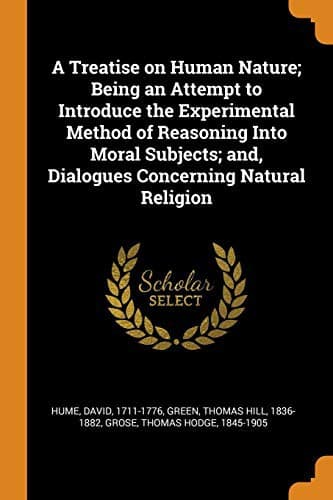
A Treatise of Human Nature: Being an Attempt to Introduce the Experimental Method Into Moral Subjects; and Dialogues Concerning Natural ReligionHume, David
PhilosophyPhilosophy
A Treatise of Human Nature: Being an Attempt to Introduce the Experimental Method Into Moral Subjects; and Dialogues Concerning Natural Religion
Hume, David
Emotions; Ethics; Knowledge, Theory of; Philosophy, English
29. The two considerations here mentioned, of ‘ideas as actually
in our minds,’ of ‘things as actually without us,’ are meant
severally to represent the two ways of reflection and sensation,
by which the idea of existence is supposed to be suggested. But
sensation, according to Locke, is an organ of ‘ideas,’ just as much
as reflection. Taking his doctrine strictly, there are no ‘objects’
but ‘ideas’ to suggest the idea of existence, whether by the way of
sensation or by that of reflection, and no ideas that are not ‘in the
mind.’ (Book II. chap. ix. sec. 3, &c.)
Existence as the mere presence of a feeling.
30. The designation of the idea of existence, then, as ‘suggested
by every idea within,’ covers every possible suggestion. It can
mean nothing else than that it is given in every act and mode of
consciousness; that it is inseparable from feeling as such, being
itself at the same time a distinct simple idea. This, we may remark
by the way, involves the conclusion that every idea is composite,
made up of whatever distinguishes it from other ideas together with
the idea of existence. Of this idea of existence itself, however,
it will be impossible to say anything distinctive; for, as it
accompanies all possible objects of consciousness, there will be no
cases where it is absent to be distinguished from those where it is
present. Not merely will it be undefinable, as every simple idea is;
it will be impossible ‘to send a man to his senses’ (according to
Locke’s favourite subterfuge) in order to know what it is, since it
is neither given in one sense as distinct from another, nor in all
senses as distinct from any other modification of consciousness. Thus
regarded, to treat it as a simple idea alongside of other simple
ideas is a palpable contradiction. It is the mere ‘It is felt,’ the
abstraction of consciousness, no more to be reckoned as one among
other ideas than colour in general is to be co-ordinated with red,
white, and blue. Whether I smell a rose in the summer or recall the
smell in winter; whether I see a horse or a ghost, or imagine a
centaur or think of gravitation or the philosopher’s stone--in every
case alike the idea or ‘immediate object of the mind’ _exists_. Yet
we find Locke distinguishing between real ideas, as those that ‘have
a conformity with the existence of things,’ and fantastic ideas, as
those which have no such conformity (Book II. chap. xxx. sec. 1); and
again in the fourth book (chap. i. sec. 7, chap. iii. sec. 21, &c.)
he makes the perception of the agreement of an idea with existence a
special kind of knowledge, different from that of agreement of idea
with idea; and having done so, raises the question whether we have
such a knowledge of existence at all, and decides that our knowledge
of it is very narrow.
Existence as reality.
Public-domain text, read in full here on John Shaqi.
Reviews
Reviews
No reviews yet
Be the first to share your thoughts on this work.
Join the Discussion
Join the discussion
Sign in to leave a comment or review.
Sign InorCreate an account