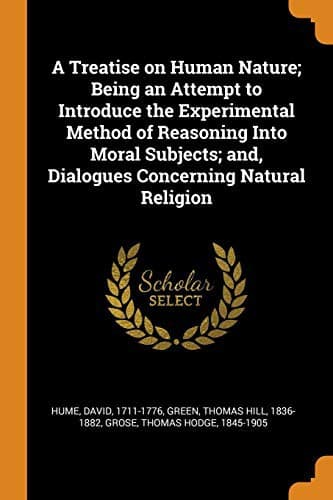
A Treatise of Human Nature: Being an Attempt to Introduce the Experimental Method Into Moral Subjects; and Dialogues Concerning Natural ReligionHume, David
PhilosophyPhilosophy
A Treatise of Human Nature: Being an Attempt to Introduce the Experimental Method Into Moral Subjects; and Dialogues Concerning Natural Religion
Hume, David
Emotions; Ethics; Knowledge, Theory of; Philosophy, English
by a name,’ form the essence of each particular existence, to which
the same name is applied (Book III. chap. iii. secs. 12 and the
following.) Such essence, however, according to Locke, is ‘nominal,’
not ‘real.’ It is a complex--fuller or emptier--of ideas in us,
which, though it is a ‘uniting medium between a general name and
particular beings,’ [2] in no way represents the qualities of the
latter. These, consisting in an ‘internal constitution of insensible
parts,’ form the ‘real essence’ of the particular beings; an essence,
however, of which we can know nothing. (Book III. chap. vi. sec. 21,
and ix. sec. 12.)
[1] Book III. chap, iii, sec. 7, at the end.
[2] Book III chap. iii. sec. 13.
Only to nominal essences that general propositions relate, _i.e._
only to abstract ideas having no real existence.
81. It is the formation of ‘nominal essences’ that renders general
propositions possible. ‘General certainty,’ says Locke, ‘is never to
be found but in our ideas. Whenever we go to seek it elsewhere in
experiment or observation without us, our knowledge goes not beyond
particulars. It is the contemplation of our own abstract ideas, that
alone is able to afford us general knowledge.’ (Book IV. chap. vi.
sec. 16.) ‘General knowledge,’ he says again, ‘lies only in our own
thoughts.’ [1] This use of ‘our ideas’ and ‘our own thoughts’ as
equivalent phrases, each antithetical to ‘real existence,’ tells
the old tale of a deviation from ‘the new way of ideas’ into easier
paths. According to this new way in its strictness, as we have
sufficiently seen, there is nowhere for anything to be found but ‘in
our ideas.’ It therefore in no way distinguishes general knowledge
or certainty that it cannot be found elsewhere. Locke, however,
having allowed himself in the supposition that simple ideas report a
real existence, other than themselves, but to which they are related
as ectype to archetype, tacitly proceeds to convert them into real
existences, to which ideas in general, as mere thoughts of our own,
may be opposed. Along with this conversion, there supervenes upon
the original distinction between simple and complex ideas, which
alone does duty in the Second Book of the Essay, another distinction,
essential to Locke’s doctrine of the ‘reality’ of knowledge--that
between the idea, whether simple or complex, as originally given in
sensation, and the same as retained or reproduced in the mind. It is
only in the former form that the idea, however simple, reports, and
thus (with Locke) itself is, a real existence. Such real existence
is a ‘particular’ existence, and our knowledge of it a ‘particular’
knowledge. In other words, according to the only consistent doctrine
that we have been able to elicit from Locke, [2] ‘it is a knowledge
which consists in a consciousness, upon occasion of a present
sensation--say, a sensation of redness--that some object is present
here and now causing the sensation; an object which, accordingly,
Public-domain text, read in full here on John Shaqi.
Reviews
Reviews
No reviews yet
Be the first to share your thoughts on this work.
Elsewhere in the archive
Join the Discussion
Join the discussion
Sign in to leave a comment or review.
Sign InorCreate an account