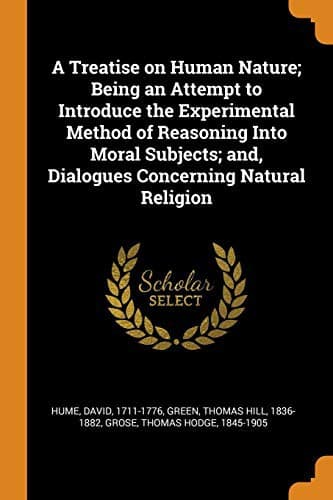
A Treatise of Human Nature: Being an Attempt to Introduce the Experimental Method Into Moral Subjects; and Dialogues Concerning Natural ReligionHume, David
PhilosophyPhilosophy
A Treatise of Human Nature: Being an Attempt to Introduce the Experimental Method Into Moral Subjects; and Dialogues Concerning Natural Religion
Hume, David
Emotions; Ethics; Knowledge, Theory of; Philosophy, English
must be ‘particular’ or transitory as the sensation. The ‘here and
now,’ as in such a case they constitute the particularity of the
object of consciousness, so also render it a real existence. Separate
these (‘the circumstances of time and place’ [3]) from it, and it
at once loses its real existence and becomes an ‘abstract idea,’
one of ‘our own thoughts,’ of which as ‘in the mind’ agreement or
disagreement with some other abstract idea can be asserted in a
general proposition; _e.g._ ‘red is not blue.’ (Book IV. chap. vii.
sec. 4.) [4]
[1] Book IV. chap. vi. sec. 13, cf. Book IV. chap. iii. sec. 31.
[2] See above, paragraph 56.
[3] Book III. chap. iii. sec. 6.
[4] In case there should be any doubt as to Locke’s meaning in this
passage, it may be well to compare Book IV. chap. ix. sec. 1. There
he distinctly opposes the consideration of ideas in the understanding
to the knowledge of real existence. Here (Book IV. chap. vii. sec.
4) he distinctly speaks of the proposition ‘red is not blue’ as
expressing a consideration of ideas in the understanding. It follows
that it is not a proposition as to real existence.
An abstract idea may be a simple one.
82. It is between simple ideas, it will be noticed, that a relation
is here asserted, and in this respect the proposition differs from
such an one as may be formed when simple ideas have been compounded
into the nominal essence of a thing, and in which some one of these
may be asserted of the thing, being already included within the
meaning of its name; _e.g._ ‘a rose has leaves.’ But as expressing a
relation between ideas ‘abstract’ or ‘in the mind,’ in distinction
from present sensations received from without, the two sorts of
proposition, according to the doctrine of Locke’s Fourth Book, stand
on the same footing.’ [1] It is a nominal essence with which both
alike are concerned, and on this depends the general certainty or
self-evidence, by which they are distinguished from ‘experiment
or observation without us.’ These can never ‘reach with certainty
farther than the bare instance’ (Book IV. chap. vi. sec. 7): _i.e._,
though the only channels by which we can reach real existence, they
can never tell more than the presence of this or that sensation as
caused by an unknown thing without, or the present disagreement of
such present sensations with each other. As to the recurrence of such
sensations, or any permanently real relation between them, they can
tell us nothing. Nothing as to their recurrence, because, though in
each case they show the presence of something causing the sensations,
they show nothing of the real essence upon which their recurrence
depends. [2] Nothing as to any permanently real relation between
them, because, although the disagreement between ideas of blue and
red, and the agreement between one idea of red and another, _as in
the mind_, is self-evident, yet as thus in the mind they are not
‘actual sensations’ at all (Book IV. chap. xi. sec. 6), nor do they
Public-domain text, read in full here on John Shaqi.
Reviews
Reviews
No reviews yet
Be the first to share your thoughts on this work.
Elsewhere in the archive
Join the Discussion
Join the discussion
Sign in to leave a comment or review.
Sign InorCreate an account