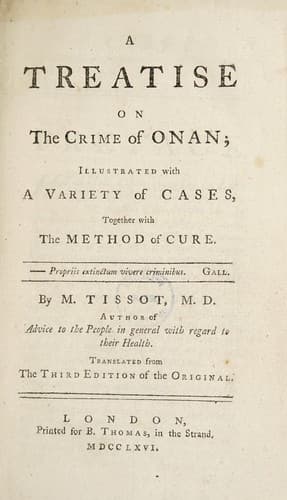
A Treatise on the Crime of Onan: Illustrated with a Variety of Cases, Together with the Method of CureTissot, S. A. D. (Samuel Auguste David)
Science
A Treatise on the Crime of Onan: Illustrated with a Variety of Cases, Together with the Method of Cure
Tissot, S. A. D. (Samuel Auguste David)
Masturbation -- Early works to 1800; Sexual ethics -- Early works to 1800
“All the evils which arise from excesses committed with women, are also
effected in early life, by that abominable practice in school-boys,
a practice which I cannot describe in terms odious enough, _pollutio
sui_, which, actuated more by vitiousness than by sense and reason, and
ignorant of the mischievous consequences, they repeat, &c. &c.[31] ... So
intimately are the mind and body blended together, that there cannot be
any disease of the one which will not influence the other; but in none is
the _mind_ more deeply affected than in this. To add to his infelicity,
a melancholy gloom attends the patient, and silence and solitude are
anxiously sought after.—The chearful haunts of men no longer delight him;
he is absent in company, and will have no part of the conversation. He
is not happy even in his friend: a sense of his misfortune, and perhaps
the aggravating circumstance of having brought it upon himself, for ever
hang on his mind. The company of the female sex he loves indeed, but the
apprehensions that he may be cut off from nuptial felicity, interrupts
the fruition of their pleasing converse. Thus deeply dejected, he
excludes himself from society, wanders in retirement, and it is well if
he seeks not to destroy himself at last[32].”
Fresh observations, subsequently introduced, will confirm the truth of
the preceding dreadful description. That one furnished by M. STORCKE,
in the valuable work which he has published on the history and cure of
diseases, is not less terrible: but I refer the curious to the work
itself, which no physician would wish to be without. The passage I
allude to is in his _Medicus annuus_, T. ii. p. 215, &c. But before I
terminate this Section, I shall here conclusively add a passage in that
excellent work, with which M. GAUBIUS has lately enriched the medical
art. He not only paints the evils, but points out the causes of them,
with that force, that truth, that sagacity, that exactness, which can
belong to none but so great a master. It is a most valuable extract;
and that the coloring of it may appear in its true lustre, I subjoin
to the translation the original of it, in the language of the author’s
expression.
Public-domain text, read in full here on John Shaqi.
Reviews
Reviews
No reviews yet
Be the first to share your thoughts on this work.
Join the Discussion
Join the discussion
Sign in to leave a comment or review.
Sign InorCreate an account