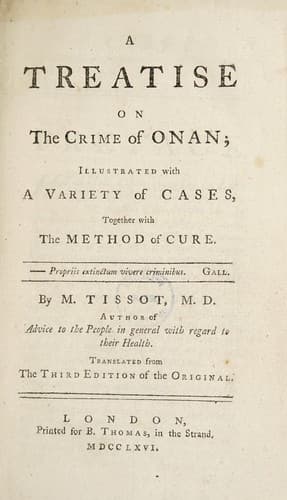
A Treatise on the Crime of Onan: Illustrated with a Variety of Cases, Together with the Method of CureTissot, S. A. D. (Samuel Auguste David)
Science
A Treatise on the Crime of Onan: Illustrated with a Variety of Cases, Together with the Method of Cure
Tissot, S. A. D. (Samuel Auguste David)
Masturbation -- Early works to 1800; Sexual ethics -- Early works to 1800
GALEN adopts his ideas. “This humor” (says he) “is but the most
subtile, the most refined part of all the others. It has its proper
veins and nerves, which carries it from the whole body, to the seminal
repositories, the testicles[55].”
In another place, he says: “The loss of the seed is at the same time
attended with a loss of vital spirit, so that it is no wonder that
over-frequent coition should enervate the constitution, since it deprives
the body of its purest essence[56].”
The same author has preserved to us, in his History of Philosophy, the
opinions of several philosophers on this subject. May I be allowed to
recite them here?
ARISTOTLE, whose works of natural philosophy will be in esteem as long as
the value of observations shall be known, with a just allowance at once
for the merit and the difficulty of opening the career of them, calls it
“_the excretion of the ultimate aliment_, (which, in terms more clear,
signifies the most perfectly elaborated part of our aliments) _endowed
with the faculty of reproducing bodies in the likeness of that whereby it
was itself produced_.”
PYTHAGORAS calls it, “_the flower, or quintessence of the purest blood_.”
ALCMÆON, his disciple, a great naturalist and an eminent physician, one
of the first that discovered the importance of dissecting animals, and
of all the heathen philosophers, he that appears to have had the truest
ideas of the nature of the soul, ALCMÆON, I say, calls the seed “_a
portion of the brain_.”
PLATO termed it, “_an emanation from the spinal marrow_.”
DEMOCRITUS thought of it as HIPPOCRATES and GALEN.
EPICURE, that respectable character, who better knew than any one, that
it was pleasure alone that constituted the happiness of man, but who
at the same time fixed the nature of those pleasures by such rules as
the Christian Hero would not disown, or object to them: yes, EPICURE,
whose doctrine has been so cruelly disfigured and blackened by the
Stoics, that those who knew nothing of him but through the chanel of
their information, have suffered themselves to be misled by it in their
opinion, to such a degree, that they have mistaken for a libertine, a
debauchee, a man, “who (as M. FENELON observes) was of an exemplary
continency, and whose morals were extremely regular.” To which I shall
add, that his principles are the most severe censure on the tenets of
his _pretended_ modern sectaries, who knowing nothing of him but his
name, most basely and unworthily misuse it, by employing it to authorise
systems of infamy, which he would abhor, and by which those men of
probity and sense, who love the truth, ought not to permit his memory to
be dishonoured, if so it was that men, themselves lost to honour, could
dishonour any one. EPICURE, I say, looked on the seed as a particle of
the soul and the body, and grounded, upon this idea, his precepts for the
chary preservation of it.
Public-domain text, read in full here on John Shaqi.
Reviews
Reviews
No reviews yet
Be the first to share your thoughts on this work.
Join the Discussion
Join the discussion
Sign in to leave a comment or review.
Sign InorCreate an account