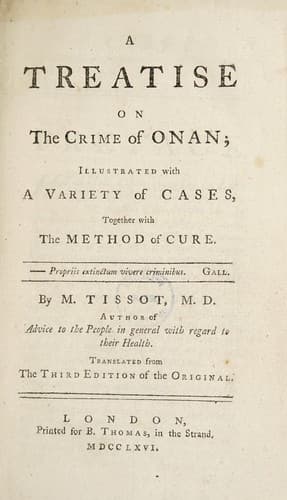
A Treatise on the Crime of Onan: Illustrated with a Variety of Cases, Together with the Method of CureTissot, S. A. D. (Samuel Auguste David)
Science
A Treatise on the Crime of Onan: Illustrated with a Variety of Cases, Together with the Method of Cure
Tissot, S. A. D. (Samuel Auguste David)
Masturbation -- Early works to 1800; Sexual ethics -- Early works to 1800
I answer, in the first place, that examples of this kind, and too
frequent not to be generally known, ought to obviate such an objection.
Who might not have observed, that an evacuation of milk (to go no further
than that instance) though moderate and of no long duration, is capable
of weakening a nurse that has not a strong constitution, to such a
degree, that she may feel the influences of it for the rest of her life?
And even the robustest would sink under it, if continued beyond a certain
length of time. The reason is sensibly apparent. Upon evacuating too
often the reservoirs appropriated to the reception of any liquid, the
humors are, by a necessary consequence of the laws of the animal machine,
determined to an afflux thither in the greater abundance. This secretion
becomes excessive, all the others suffer by it, and especially nutrition,
which is but a kind of secretion; the animal constitution falls into
languor and debility.
Secondly, There is an answer, relative to the seed which does not hold
as to the milk, which is only a liquid simply nutritious, of which
an over-abundant secretion does no detriment, but in so much as it
diminishes the quantity of humors: whereas the seed is an active liquid,
of which the presence produces effects necessary to the play of the
organs, which ceases on its evacuation; a liquid, of which, for that very
reason, the superfluous emission is detrimental, in a double view. This
requires explanation.
There are humors, such as those of the sweat and perspiration, which
leave the body as soon as they are separated from the other humors, and
thrown out by the vessels of circulation.
There are others, such as the urine, which, after this separation and
expulsion, are retained, for a certain time, in reservoirs appropriated
for that purpose, and out of which they are not discharged, but when
they are in a quantity great enough to excite, in those reservoirs, an
irritation that mechanically forces them to void them.
Public-domain text, read in full here on John Shaqi.
Reviews
Reviews
No reviews yet
Be the first to share your thoughts on this work.
Join the Discussion
Join the discussion
Sign in to leave a comment or review.
Sign InorCreate an account