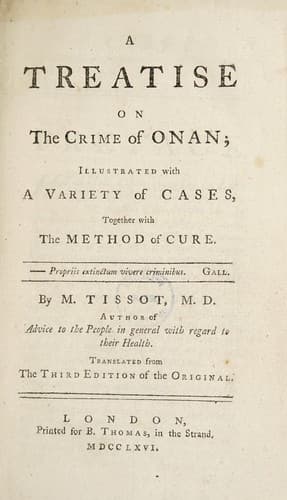
A Treatise on the Crime of Onan: Illustrated with a Variety of Cases, Together with the Method of CureTissot, S. A. D. (Samuel Auguste David)
Science
A Treatise on the Crime of Onan: Illustrated with a Variety of Cases, Together with the Method of Cure
Tissot, S. A. D. (Samuel Auguste David)
Masturbation -- Early works to 1800; Sexual ethics -- Early works to 1800
M. CLIFTON WINTRINGHAM has very sensibly particularised the dangers of
this evacuation with respect to the gouty, and his explanation merits
attention[79].
The late M. GUNZIUS, snatched from the medical career in the flower of
his age, has given a very ingenious mechanical explanation[80] of the
inconveniences resulting from this excess to the faculty of respiration.
He speaks, on this occasion, of a man who had thereby brought upon
himself a continual cough; a symptom which I myself observed in a young
man who died a victim of self-pollution.
He was come to Montpelier, to pursue there his studies. His excesses in
that infamous practice had thrown him into a consumption, and I recollect
that his cough was so strong and so continual, that it disturbed all
his neighbours. He was frequently blooded, which must have been, I
supposed, by way of making the quicker dispatch of his sufferings. A
consultation on his case, prescribed his going home, and living there
upon turtle-broth. His residence was, if I am not mistaken, in Dauphiny.
The persons consulted promised him a complete cure; but he died two hours
after the consultation. How curious an one! and what physicians must
they have been who were consulted!
But what is the least easy to conceive, or rather, what is beyond all
comprehension, is, that of its prodigious weakening of the faculties of
the soul.
The solution of this problem is connected with the question
undeterminable by us, of the mutual influence of the two substances
upon each other, upon which we are reduced to the observation of these
phenomenons, without being able to account for them. We are ignorant of
the nature both of the spirit and of the body; but we know that they are
so intimately united, that all the changes that the one undergoes are
felt by the other: a circulation a little more or less quick, the blood
a little more or less thick, some ounces more or less of aliments, the
same quantity of one aliment rather than of another, a dish of coffee
instead of a glass of wine, a sleep more or less long or tranquil, a
stool a little more or less copious, a perspiration too profuse or too
languid, will totally change our manner of seeing or judging of objects:
From one hour to another, the revolutions of the machine bring with them
different sensations, different thoughts, and, arbitrarily, form to us
new principles of vices and of virtues; so just is the idea of the poet
who first wrote Satires in France.
_Tout, suivant l’intellect, change d’ordre et de rang:_
_Ainsi, c’est la nature et l’humeur des personnes,_
_Et non la qualité, qui rend les choses bonnes,_
_C’est un mal bien etrange au cerveau des humains._[81]
So exact is the description which LUCRETIUS has furnished of this
intimate union:
Public-domain text, read in full here on John Shaqi.
Reviews
Reviews
No reviews yet
Be the first to share your thoughts on this work.
Join the Discussion
Join the discussion
Sign in to leave a comment or review.
Sign InorCreate an account