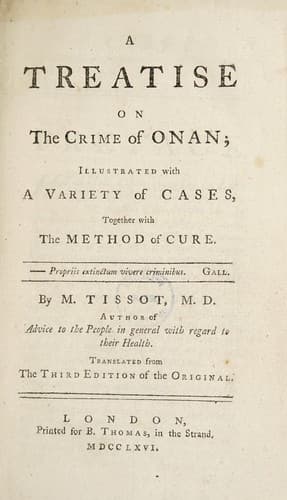
A Treatise on the Crime of Onan: Illustrated with a Variety of Cases, Together with the Method of CureTissot, S. A. D. (Samuel Auguste David)
Science
A Treatise on the Crime of Onan: Illustrated with a Variety of Cases, Together with the Method of Cure
Tissot, S. A. D. (Samuel Auguste David)
Masturbation -- Early works to 1800; Sexual ethics -- Early works to 1800
That joy which is allied to the soul, and which it is so very right
essentially to distinguish from that merely corporal pleasure, in
which the man shares but with the brute, and from which it is totally
different; that joy, I say, aids the digestions, animates circulation,
favors all the functions, restores the vital forces, cherishes, and
supports them. Where it is found combined or united with the pleasures
of love, it contributes to repair that strength which those pleasures
may have diminished or exhausted. This stands proved by observation.
SANCTORIUS has remarked it.
“A man (says he) after an excessive coition with a woman he loves, and
has passionately desired, does not feel that fatigue of weakness which
one would naturally suppose would be the consequence of such an excess;
because the joy of the soul augments the power of the heart, favors the
functions, and repairs the losses.”
It is upon this principle that VENETTE, in whose work there may be seen
a good chapter on the dangers of pushing the pleasures of love to an
excess, establishes it as a maxim, that an union with a beautiful woman
is less apt to exhaust the strength, than with a homely one.
“Beauty (says he) has charms which dilate the heart, and multiply the
vital spirits, that proceed from it. We may very well believe, with St.
CHRYSOSTOM, that to excite one’s self repugnantly to the laws of nature,
is, in that respect, a much greater crime than the other.”
And, in fact, can there be a doubt of Nature’s not having annexed more
joy to the pleasures procured by the means which are in her appointed
course, than by any which are out of it?
An eighth and last cause which augments the dangers of self-pollution, is
the regrets, the horrors, which cannot fail of being the consequence of
it, when once one’s eyes come to be opened on the crime and its dangers.
_Miseri quorum gaudia crimen habent!_
_Wretched are those joys which are obnoxious to remorse!_
And, surely, if there are any human beings in this case, the
self-pollutors must be among them.
When the veil is drawn, the representation of their conduct appears to
them in all its most hideous colors and aspects. They find themselves
guilty of a crime, of which divine justice would not postpone the
punishment, but punished it immediately with death; a crime reputed a
very great one even by the heathens themselves.
_Hoc nihil esse putas! scelus est; mihi crede, sed ingens_
_Quantum, vix, animo concipis ipse tuo._
MART.
Public-domain text, read in full here on John Shaqi.
Reviews
Reviews
No reviews yet
Be the first to share your thoughts on this work.
Join the Discussion
Join the discussion
Sign in to leave a comment or review.
Sign InorCreate an account