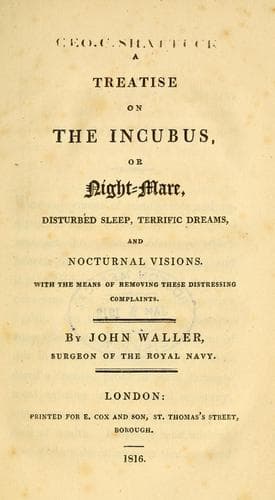
A Treatise on the Incubus, or Night-Mare, Disturbed Sleep, Terrific Dreams and Nocturnal VisionsWaller, John Augustine
HistoryChristian
A Treatise on the Incubus, or Night-Mare, Disturbed Sleep, Terrific Dreams and Nocturnal Visions
Waller, John Augustine
Nightmares; Sleep disorders
Hence it is easy to conceive, how many well-meaning persons may frequently
deceive themselves and others with the belief of having seen spectres,
heard voices, &c. in the dead of the night; and it is not very improbable
that a well-grounded conviction in the mind of any person, of having
received a supernatural warning of their approaching fate, should, under
certain circumstances, be productive of the very event which was thus
foreboded and dreaded. I could relate a number of instances where the
visions accompanying paroxysms of _Incubus_, have been of the most
terrific kind.[3] I think enough has been said on that subject to shew how
easily a person may be deceived where he thinks he has the evidence of his
own senses; and I have selected such histories in my own case to
illustrate this truth by, as were least likely to be suspected of arising
from fright or terror, or any cause that could be much aided by the
imagination.
I wish it, however, to be understood, that I by no means intend to explain
by this hypothesis, all the extraordinary accounts of supernatural
operations which are given us on indubitable authority, and supported by
unquestionable evidence. I am aware that there are a great many cases to
which it will not apply, neither can any one principle possibly explain
them all. I have been very much surprised to see a late medical writer on
the subject of apparitions, attempt to explain all the cases he has
adduced, by supposing the disease to exist, so ably described by Nicolai,
and of which several cases have been given by Dr. Alderson of Hull.
He has himself recorded several instances of spectres, which appear to be
closely connected with the death of persons at a distance, and with some
of the most important circumstances in the lives of the persons who saw
these appearances: he even admits the truth of these instances, yet
ascribes the most important circumstances attending them to chance.
Of all the modes of solving difficulties, which mankind have ever had
recourse to, this is certainly the least _philosophical_. In the present
age however it appears to be considered still more _unphilosophical_ to
acknowledge that any phenomenon, however extraordinary, is above our
comprehension.
Public-domain text, read in full here on John Shaqi.
Reviews
Reviews
No reviews yet
Be the first to share your thoughts on this work.
Join the Discussion
Join the discussion
Sign in to leave a comment or review.
Sign InorCreate an account