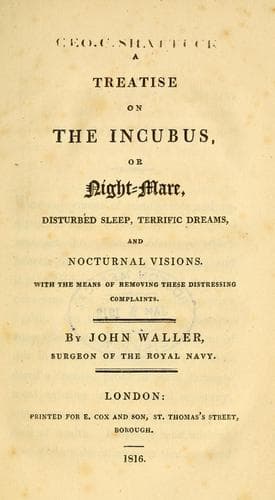
A Treatise on the Incubus, or Night-Mare, Disturbed Sleep, Terrific Dreams and Nocturnal Visions — John Shaqi
A Treatise on the Incubus, or Night-Mare, Disturbed Sleep, Terrific Dreams and Nocturnal VisionsWaller, John Augustine
HistoryChristian
A Treatise on the Incubus, or Night-Mare, Disturbed Sleep, Terrific Dreams and Nocturnal Visions
Waller, John Augustine
Nightmares; Sleep disorders
This affection may at some time or other occur to any person whatever, as
it will for the most part be found to be the constant attendant upon
indigestion: now the most healthy person in the world will sometimes meet
with food which his stomach will not digest, and if he goes to sleep
whilst such food is remaining in the stomach, or in the superior portion
of the alimentary canal, he will certainly be affected with Night-Mare, to
a greater or less degree. But a peculiar habit of body is necessary to
render a person subject to it, so that it can become habitual. Many
persons begin to feel its effects in very early youth; these are generally
of a contemplative disposition, and of a peculiar temperament, which
renders them liable to hypochondriasis and nervous diseases. To these
persons the Night-Mare often becomes habitual. All who follow sedentary
employments, or whose avocations keep them mostly in doors, more
especially literary characters, and all studious persons, are the victims
of these affections. Those likewise, who, although they do not want for
air and exercise, yet are accustomed to a coarse and unwholesome diet;
hence sailors are, of all classes of men, the most subject to Night-Mare
and terrific dreams. All hypochondriacs, and frequently pregnant women,
are amongst the subjects of these affections.
It occasionally accompanies fever and other acute diseases. I remember one
patient to whom it became extremely troublesome in the last stage of
consumption, who had never before in her life been affected by it. Sylvius
Deleboe, who has recorded the _history_ of an epidemic disease, which
raged in the city of Leyden, in the year 1669, mentions the Incubus as a
very common affection in it, with which he was himself afflicted to a
great degree. He describes it as accompanied with an unusual degree of
somnolency, and making its attack on the accession of the febrile
paroxysm. Perhaps it was something of this kind, which Cœlius Aurelianus
asserts to have been epidemic at Rome. Sylvius relates that the lethargy,
or propensity to sleep, was so great during the febrile paroxysm, and
accompanied with so unpleasant a sensation, even when Night-Mare did not
come on, that he thought proper to order himself, as well as his patients,
to be kept awake by the attendants. He describes it thus: “_Non tantum cum
Incubo, sed absque ipso gravis fuit ægris multis Somnus profundus, et
insomniis multifariis molestus_.” In another place, “_Nec tantum sola
difficili respiratione laborarunt multi, verum etiam Incubo nonnulli, et
inter ipsos ego quoque; qui cum paroxysmis febrilibus repetens atque
somnolentiam simul excitans, fuit mihi valdè molestus, donec ipsum
agnoscens rogarem adstantes, ut tamdiu somnum in quem tam valde
propendebam, interturbarent ac impedirent, donec paroxysmo declinante in
somnum suavem ac commodum inciderem absque omni incubo_.” Sylvii Praxeos.
Med. Tract. x.
Public-domain text, read in full here on John Shaqi.
Reviews
Reviews
No reviews yet
Be the first to share your thoughts on this work.
Join the Discussion
Join the discussion
Sign in to leave a comment or review.
Sign InorCreate an account