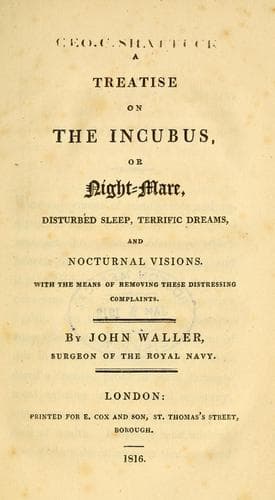
A Treatise on the Incubus, or Night-Mare, Disturbed Sleep, Terrific Dreams and Nocturnal VisionsWaller, John Augustine
HistoryChristian
A Treatise on the Incubus, or Night-Mare, Disturbed Sleep, Terrific Dreams and Nocturnal Visions
Waller, John Augustine
Nightmares; Sleep disorders
I must confess I have not hitherto been able to find any satisfactory
explanation of the phenomena which take place during Night-Mare. The
following observations which I have been able to make on the paroxysm
itself, and on the more immediate causes which give rise to it, may
possibly direct some happier genius to a more correct idea of its nature.
1st. I have frequently experienced that this affection may occur in very
profound sleep, without breaking or disturbing that sleep, any farther
than to produce a dream, the memory of which will remain after waking, in
the same manner as that of any other impressive dream. Thus I have
frequently dreamed that I had Night-Mare; supposing myself to be in a
place, and under circumstances very different to those in which I really
was. Under these circumstances I have never become conscious of the real
situation in which I was, but on waking, remembered very well that I had
been dreaming of labouring under Night-Mare. From this circumstance I
conclude, that the Night-Mare is not, as Dr. Darwin insinuates, a state of
imperfect sleep, but an absolute disease, which may occur, and go through
its regular stages, whilst the patient continues to be, to all intents and
purposes, in a natural sleep. There is no doubt but the disease, in this
case, is much slighter than ordinary, although the impression made upon
the mind may be very strong.
2nd. It happens still more frequently, that the patient is in a state
apparently between sleeping and waking, when the paroxysm takes place;
which has given rise to the belief, in many persons, that it came on
while awake. I have often heard it described by others, (and have felt it
myself) as a sense of weight, first upon the feet, and progressively
advancing towards the breast, until the paroxysm becomes complete. In the
beginning of this state of things, it appears to the patient that he might
easily, if he would, move himself, and shake off the incumbent weight. He
does not feel at all aware at that moment, of the suspension of the power
of volition; nor does he feel any inconvenience from that circumstance
until he begins to experience a necessity of exerting that power, in order
to carry on the function of respiration. It is not until the involuntary
action of the muscles concerned in respiration, in some measure ceases,
that the patient perceives that he is absolutely labouring under
Night-Mare.
Public-domain text, read in full here on John Shaqi.
Reviews
Reviews
No reviews yet
Be the first to share your thoughts on this work.
Join the Discussion
Join the discussion
Sign in to leave a comment or review.
Sign InorCreate an account