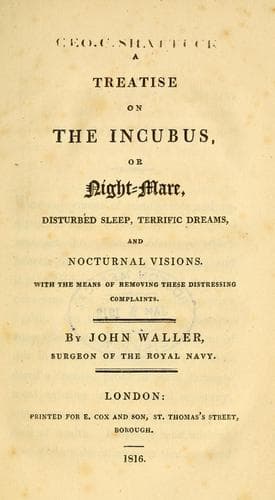
A Treatise on the Incubus, or Night-Mare, Disturbed Sleep, Terrific Dreams and Nocturnal VisionsWaller, John Augustine
HistoryChristian
A Treatise on the Incubus, or Night-Mare, Disturbed Sleep, Terrific Dreams and Nocturnal Visions
Waller, John Augustine
Nightmares; Sleep disorders
First then, this disease attacks always during sleep. This is a truth of
which I am now well assured, although frequently the evidence of my senses
has apparently produced a contrary conviction. Whatever may be the
situation of the patient at the moment previous to the invasion of the
disease, he is at that moment asleep, although the transition from the
waking to the sleeping state may be so rapid as to be imperceptible. I
will explain this part of the subject more fully by and by, at present we
will assume the fact, and proceed to enumerate the symptoms. If the
patient be in a profound sleep, he is generally alarmed with some
disagreeable dream; he imagines that he is exposed to some danger, or
pursued by some enemy which he cannot avoid; frequently he feels as
though his legs were tied, or deprived of the power of motion; sometimes
he fancies himself confined in some very close place, where he is in
danger of suffocation, or at the bottom of a cavern or vault from which
his return is intercepted. It will not unfrequently happen, that this is
the whole of the sensation which the disease, for the time, produces, when
it goes off without creating any further annoyance: the patient either
falls into an oblivious slumber, or the alarming dream is succeeded by one
more pleasant. In this case the disease is not fully formed, but only
threatens an invasion; it proves however that the pre-disposition to it
exists, and that the person is in danger of it. But when the paroxysm does
actually take place, the uneasiness of the patient in his dream rapidly
increases, till it ends in a kind of consciousness that he is in bed, and
asleep; but he feels to be oppressed with some weight which confines him
upon his back and prevents his breathing, which is now become extremely
laborious, so that the lungs cannot be fully inflated by any effort he can
make. The sensation is now the most painful that can be conceived; the
person becomes every instant more awake and conscious of his situation: he
makes violent efforts to move his limbs, especially his arms, with a view
of throwing off the incumbent weight, but not a muscle will obey the
impulse of the will: he groans aloud, if he has strength to do it, while
every effort he makes seems to exhaust the little remaining vigour. The
difficulty of breathing goes on increasing, so that every breath he draws,
seems to be almost the last that he is likely to draw; the heart generally
moves with increased velocity, sometimes is affected with palpitation; the
countenance appears ghastly, and the eyes are half open. The patient, if
left to himself, lies in this state generally about a minute or two, when
he recovers all at once the power of volition: upon which he either jumps
up in bed, or instantly changes his position, so as to wake himself
thoroughly. If this be not done, the paroxysm is very apt to recur again
immediately, as the propensity to sleep is almost irresistible, and, if
Public-domain text, read in full here on John Shaqi.
Reviews
Reviews
No reviews yet
Be the first to share your thoughts on this work.
Join the Discussion
Join the discussion
Sign in to leave a comment or review.
Sign InorCreate an account