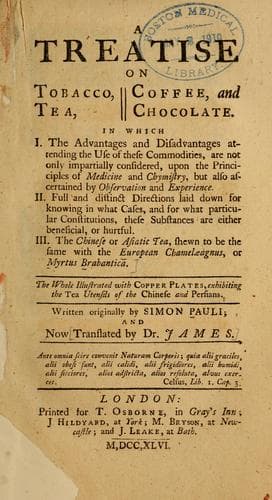
A Treatise on Tobacco, Tea, Coffee, and ChocolatePaulli, Simon
History
A Treatise on Tobacco, Tea, Coffee, and Chocolate
Paulli, Simon
Chocolate -- Early works to 1800; Coffee -- Early works to 1800; Tea -- Early works to 1800; Tobacco -- Early works to 1800
Stomach, and the third to purge the Kidnies from Stones and Gravel."
_Bernardus Varenius_, in _Descript. Regni Japoniæ, Cap. 23._ speaks in
the following Manner: "Not only the _Japonese_, but also the _Chinese_,
are delighted with Draughts of almost boiling Water, in which the
Powder of _Tea_ is sprinkled. The Herb _Tea_ is not only Green itself,
but also tinges any Liquor with the same Colour. It grows only in some,
and not in all Countries, and the finer Kind of its Leaves is thought
to be very valuable. These Leaves are, by the richer Sort, kept in
large Vessels, close stopped, in order to prevent the Access of the
Air. The Leaves, before they are used, are reduced to a Powder." And a
little after he subjoins, "This Liquor is pleasant to the Taste, and
highly salutary, especially for carrying off the Uneasiness produced
by Surfeits, and for removing all pituitous Disorders: So that it
is become a proverbial Saying, with respect to the Rich, _How is it
possible they should not enjoy good Health, since they drink the best_
Tsia?" _Olearius_, in the Work before quoted, speaks of _Tea_ in the
following Manner: "We have already observed, that at the _Maidan_
in _Ispahan_, there are, among others, particular Species of Inns,
called _Tzai_, _Chattai_, and _Chane_, in which, as well as in other
Places, the _Persians_ drink an hot, black Water, prepared of an Herb,
brought into their Country by the _Usbeck Tartars_. This Herb has
oblong pointed Leaves, about an Inch long, and half an Inch broad,
which, when dried, are of a blackish Colour, and shrivel up into the
Form of a Worm; but they are the same with what the _Chinese_ call
_Tea_, and the _Japonese_ and _Indians_, _Chia_, and _Cha_. In each of
these Nations, this Herb is highly esteemed; the _Persians_ boil it
with Spring-Water, _Anise_ and _Fennel_: Some of them also add a small
Quantity of _Cloves_ to it. The _Persians_, _Chinese_, _Japonese_,
and _Indians_, ascribe uncommon Virtue and Efficacy to this Water,
affirming, that it produces the most salutary Effects on the Stomach,
Lungs, Liver, Mass of Blood, and all the _Viscera_, which it deterges
and corroborates. It also expels the Stone, removes the Head-ach, and
dissipates that superfluous Humidity, which produces Lassitude and
Drowsiness. By drinking this Water, a Person is rendered so lively,
brisk, and alert, as chearfully to bear the Want of Sleep for several
Nights, and without any Pain, or Fatigue, apply long to Business of
the greatest Importance. This Liquor, when drank in Moderation, not
only preserves Health, but also protracts Life to an excessive old Age.
This Herb _Tea_ is, at present, well known in _Holland_, since the
_East-Indiamen_ bring large Quantities of it to _Amsterdam_." _Johannes
Albertus von Mandelslo_, in _Itinerar. Indiæ Orientalis, Cap. 11._
gives us the following memorable Account of _Tea_: "In our Visits, we
make use of the black Water, in which the Herb _Tea_ is boiled. This
Public-domain text, read in full here on John Shaqi.
Reviews
Reviews
No reviews yet
Be the first to share your thoughts on this work.
Join the Discussion
Join the discussion
Sign in to leave a comment or review.
Sign InorCreate an account