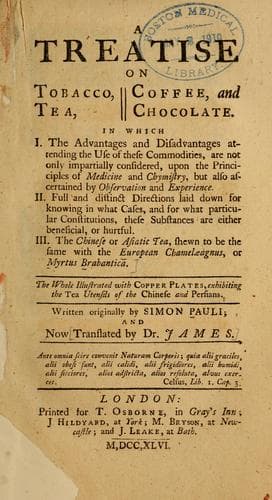
A Treatise on Tobacco, Tea, Coffee, and Chocolate — John Shaqi
A Treatise on Tobacco, Tea, Coffee, and ChocolatePaulli, Simon
History
A Treatise on Tobacco, Tea, Coffee, and Chocolate
Paulli, Simon
Chocolate -- Early works to 1800; Coffee -- Early works to 1800; Tea -- Early works to 1800; Tobacco -- Early works to 1800
of these; but, on account of their terrestrial, and somewhat hot
Parts, are violently drying; for which Crasis and Diversity of Parts,
as _Myrtle_ is but gently, or hardly, hot at all, _Galen_ calls it
cold. This Effect, therefore, mentioned by _Hippocrates_, evinces,
that _Myrtle_ consists of very subtle Parts, and is of a highly drying
Quality. I am surprized, that the Writers of the _Chinese_ History,
have not determined, whether _Tea_ was beneficial for both Sexes. The
same _Hippocrates_, in _Lib. 1. de Morb. Mulieb. Sect. 5. Ver. 6._
among other Things proper for expelling a corrupted _Fœtus_, prescribes
_Myrtle-Berries_, _Sweet Flag_, and _Lentiles_, boiled in Wine, and, a
little after, he recommends _Pessary_ of the Leaves of _Myrtle_ for the
same Purpose: And in _Lib. de Natur. Muliebr. Sect. 5._ he orders the
Fruit of the _Black Myrtle_ macerated in Water, and mixed up with fine
Flower, to be exhibited as a Medicine for rendering the Body soluble,
and opening the _Uterus_. _Galen_ also, in _Lib. 7. Med. Simpl._
informs us, "That _Myrtle_ consists of contrary and heterogeneous
Substances, that a cold and terrestrial Principle, however,
predominates in it, notwithstanding which, it has a certain subtile
Heat, in consequence of which, it is of an highly drying Nature: That
the Leaves, the Buds, the Fruit, and the Juice, have different Degrees
of Astringency; that the dried Leaves are more exsiccant than such
as are green; and that all Parts of the Plant are of an astringent
Quality, whether used internally or externally." The same Author, in
_Lib. 2. de Aliment. Facultat. Cap. 18._ affirms, that, like the Fruit
of the _Juniper_, it nourishes little, though it is possessed of a
contrary Quality: "For, _says he_, it is highly astringent; and, for
that Reason, stops Fluxes; but its Coldness does not bear a Proportion
to the Degree of its Astringency." (Circumstances which ought to be
carefully adverted to in investigating the Virtues of _Tea_, the
_Myrtle_, and the _Chamelæagnus_) "because it is not only astringent,
but also possessed of a certain Acrimony. Besides, it is peculiar to
all Aliments, possessed of a strong medicinal Quality, to lose that
Quality," (which Words I would have the Reader carefully observe) "by
boiling, roasting, or Maceration; after which they afford but little
Nourishment, and before none at all: This holds true in Onions and
Leeks." _Diascorides_, in _Lib. 1. Cap. 156_, tells us, "That the
_Myrtle_ and its Seeds are of an astringent Quality; and, that the
Juice expressed from the green Berries, produces the same Effects, is
beneficial to the Stomach, creates a Discharge of Urine, and cures the
Bites of venomous Spiders and Scorpions, if drank in Wine." He also
informs us, that there are two Kinds of _Myrtles_, in like Manner as
there are two Kinds of _Tea_, sent into _Europe_, by the _Chinese_.
_Athenæus_, in _Deipnosophist. Lib. 15._ tells us, "That such of the
Public-domain text, read in full here on John Shaqi.
Reviews
Reviews
No reviews yet
Be the first to share your thoughts on this work.
Join the Discussion
Join the discussion
Sign in to leave a comment or review.
Sign InorCreate an account