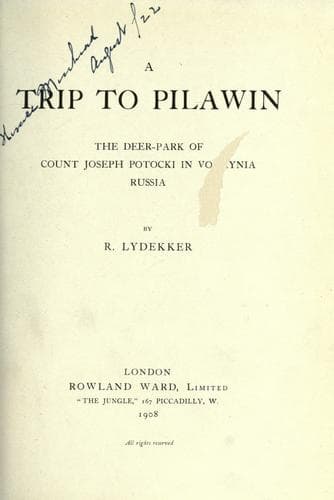
A Trip to Pilawin, the Deer-park of Count Joseph Potocki in Volhynia, Russia — John Shaqi
A Trip to Pilawin, the Deer-park of Count Joseph Potocki in Volhynia, RussiaLydekker, Richard
History
A Trip to Pilawin, the Deer-park of Count Joseph Potocki in Volhynia, Russia
Lydekker, Richard
Game reserves; Pilawin (Volhynia, Ukraine)
In addition to the species and races already represented, the
Manchurian or Bedford’s wapiti (_Cervus canadensis xanthopygus_), the
Amurland wapiti (_C. c. luedorfi_), which I have now good reason to
regard as distinct from the former, the hangul or Kashmir stag (_C.
cashmirianus_), Thorold’s deer (_C. albirostris_), and the shou or
Sikhim deer (_C. affinis_) would probably do well in the preserve,
if specimens could be procured. Sikas and wild fallow deer would of
course thrive, but the owner has no fancy for either. If smaller deer
are desired, the Himalayan musk-deer (_Moschus moschiferus_) and the
Chinese water-deer (_Hydrelaphus inermis_), as well as the Tibetan and
North Chinese tufted deer (_Elaphodus cephalophus_ and _E. michianus_),
might be recommended as interesting species likely to flourish; and,
if specimens could be procured, the milou, or Père David’s deer
(_Elaphurus davidianus_), would almost certainly prove a success.
Sheep, goats, and saigas would assuredly not do; but, despite the fact
of their being mountain species, thar, serow, and takin (at present not
procurable) might be worth a trial, as they are chiefly inhabitants of
forests.
[Illustration: EUROPEAN BISON IN A FOREST RIDE.]
The splendid condition in which the preserve is kept, and the large
amount of work already accomplished in the matter of road-making and
drainage, afford abundant testimony to the energy and capacity of Mr.
Sokalski, the director. A word of commendation may likewise be bestowed
on the relatively high degree of education of the foresters, who
display a knowledge of zoology and botany conspicuous by its absence
among most English game-keepers. Nearly all of these men are acquainted
with the scientific names of the commoner animals and plants to be met
with in the forest; and they know all the berries and funguses which
are good for food, as well as those to be shunned.
While on this point I may venture to put in a novel plea in favour of
the retention of the old-fashioned type of scientific nomenclature. My
German (so far as conversation is concerned) is but limited, while of
Polish my knowledge is _nil_. And yet, despite these drawbacks, I was
able to acquire from the director and the foresters a good knowledge
of the denizens of the forest by means of their scientific names. If,
however, I had known the white stork only by its modern designation of
_Ciconia ciconia_, instead of by its old-fashioned title of _Ciconia
alba_ (and so in other cases), a great deal of such conversation would
have been impossible.
Public-domain text, read in full here on John Shaqi.
Reviews
Reviews
No reviews yet
Be the first to share your thoughts on this work.
Join the Discussion
Join the discussion
Sign in to leave a comment or review.
Sign InorCreate an account