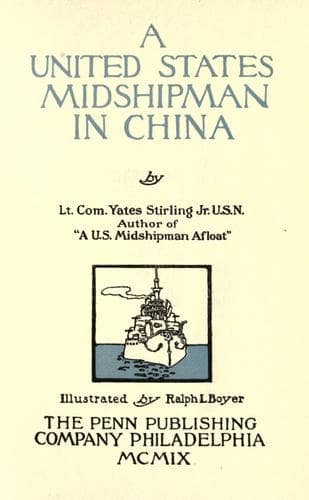
A United States Midshipman in ChinaStirling, Yates
General
A United States Midshipman in China
Stirling, Yates
China -- Juvenile fiction; United States. Navy -- Juvenile fiction
Suddenly Phil was wrenched nearly off his feet, and then fell backward
against the wall, the torn coat of the man in his hands, while the
escaping prisoner melted into the night.
Hand over hand, up the rope, it was but the work of a second to the top
of the wall, and there he found an anxious group of officers and men
who had watched, with bated breath, the struggle below them.
Phil explained the circumstances at once to Lieutenant Wilson.
“I feel sure they’re concealed all about here,” he ended excitedly. “I
heard answers to the man’s cries.”
Lieutenant Wilson turned to Langdon, who had been an eager listener.
“Is it an attack, Langdon?” he asked anxiously.
Langdon shook his head, much mystified, then the garment in Phil’s hand
caught his eye. He took it from the lad in silence and carried it down
from the wall, entering the small gate-house inside the compound.
“Keep a strict watch, Mr. Monroe,” the lieutenant ordered, motioning
Phil to follow him, and together they entered the room where Langdon
was carefully examining the garment.
It was a blue tunic, plain save for a white border and a number of
Chinese written characters on its back. It was this lettering that
Langdon was studying.
“Viceroy Chang-Li-Hun,” he read slowly aloud. Then he glanced up, a
worried expression on his usually calm face.
“Mr. Wilson,” he said, “it’s serious; we’ve the viceroy’s soldiers
against us.”
CHAPTER IV
THE EMBASSY TO THE VICEROY
If the man with whom Phil had fought was a soldier of the viceroy, it
was indeed convincing evidence that the outlaws were receiving aid of
the official class. Lieutenant Wilson at once saw the seriousness of
the situation for all foreigners living within the provinces under
the jurisdiction of Viceroy Chang-Li-Hun. The American naval man knew
that his duty required him to place this information in the hands of
his commanding officer on board the “Phœnix” immediately, in order
that all the foreign powers represented might know that the threatened
uprising was no longer one of unorganized, misguided coolies or working
men, but was at the instigation of the powerful mandarins, receiving
their instructions, no doubt, directly from the viceroy himself. Did
he dare take the risk of sending messengers out of the mission at
this time when the enemy were doubtless gathered about the walls of
the compound, perhaps even now making up their minds to attack the
defending garrison? Yet in the morning affairs might have grown even
worse: the morrow’s sun might see the mission besieged, and every
outlet barred.
Public-domain text, read in full here on John Shaqi.
Reviews
Reviews
No reviews yet
Be the first to share your thoughts on this work.
Join the Discussion
Join the discussion
Sign in to leave a comment or review.
Sign InorCreate an account