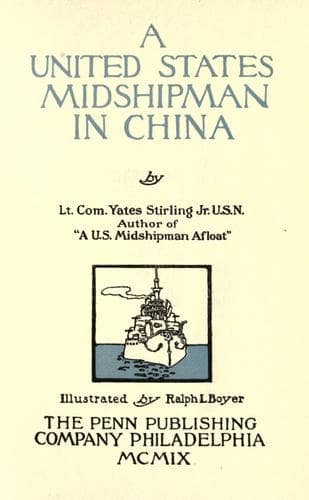
A United States Midshipman in ChinaStirling, Yates
General
A United States Midshipman in China
Stirling, Yates
China -- Juvenile fiction; United States. Navy -- Juvenile fiction
The moon had set and the land about the mission was veiled in
darkness. The men moved slowly along the wall of the compound, while
Langdon’s keen eyes peered into the night to discover the best location
to leave the mission. They had traversed nearly half of the wall and
were at the far end of the compound before the pilot seemed satisfied
that the way was clear. He put out his hand and touched Phil on the
shoulder.
“We’ll leave from here,” he whispered; “the Chinese, if they are about,
are all in the front. See; the land is clearer; there are not so many
graves as in the front to conceal an enemy.”
Throwing themselves down on top of the wall they grasped its edge, and
lowered themselves silently to the ground. Langdon led the way directly
from the mission, and further into the country. The land here was but
slightly cultivated, the ground firm and for the most part clear, so
our travelers swung along at a lively pace.
Having covered about a mile, Langdon stopped to allow his companions to
join him.
“This is the main road leading into the city,” the pilot informed them
as they arrived at the narrow path in which the speaker was standing.
“We’ll follow this right into the foreign concession; it’s late, past
ten o’clock, and there’ll be no natives on the road. It’s our safest
course.”
Phil nodded in sign of assent, his eyes on the Chinese road.
“A road, did you say, Langdon?” the boy asked; “it’s more like a
bridle-path.”
“It’s the only kind of road you’ll find in the Chinese Empire,” the
pilot replied as they moved swiftly over its uneven surface; “the
natives don’t use carriages and coaches for passengers, nor wagons to
carry their freight, but transport their merchandise in wheelbarrows or
on the backs of the small Tartar donkeys. In the north the Manchus have
a rickety cart drawn by man power or by pony and there the highways are
wider, but are even less smooth, for the natives never repair their
roads.”
They had traveled another mile when Langdon called a halt and
cautioning silence pointed to a grove of trees ahead of them.
“A village,” he answered the questioning looks of his companions;
“we’ll leave the road and circle it. The wind is from the river, so I
hope the dogs which inhabit these small towns will not smell us. These
Chinese curs have a keen nose for a foreigner and if our enemy is about
they might warn him of our presence.”
As they skirted the village Sydney glanced with interest down into
the mean and ill-smelling collection of mud-walled hovels, situated
below the level of the surrounding country. He had heard that this
location was chosen to protect its occupants from the blasts of the
winter gales, and in consequence during the wet season the floods
from the heavy and prolonged rains swept down upon them, carrying off
bodily their insecure buildings and frequently drowning many of the
unfortunate inhabitants.
“Will the Chinese ever learn to build their villages in a common-sense
way?” he asked the pilot.
Public-domain text, read in full here on John Shaqi.
Reviews
Reviews
No reviews yet
Be the first to share your thoughts on this work.
Join the Discussion
Join the discussion
Sign in to leave a comment or review.
Sign InorCreate an account