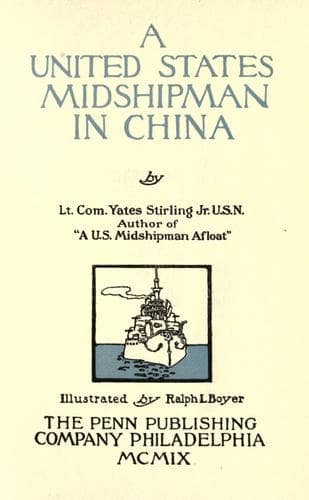
A United States Midshipman in ChinaStirling, Yates
General
A United States Midshipman in China
Stirling, Yates
China -- Juvenile fiction; United States. Navy -- Juvenile fiction
The interpreter’s face was a study; the American’s words were evidently
unexpected; he glanced uneasily at the viceroy as if fearing the storm
which he knew would break forth when the sharp words were translated
into his guttural tongue. After a few moments of thought, during
which time the old mandarin blinked his watery eyes expectantly
the interpreter spoke, hesitatingly and as one who is not sure of
his ground; but instead of the burst of rage which Phil felt was
inevitable, the old statesman nodded his head in assent.
The lad saw Langdon rise to his feet and speak in an undertone to
Commander Hughes; then the Chinese mandarins grasped the arms of their
heavily carved chairs with indignation and horror while the pilot’s
voice in their own tongue rang out loudly, in direct address to the
viceroy. Then he turned to his captain and explained his action.
“The interpreter did not give the viceroy your words, sir,” he said,
his voice quivering with emotion. “I thought it best that he should
know.”
The parchment-like features of the aged mandarin were stamped with
hatred as he snapped out his reply to his attentive interpreter.
“His Excellency is much disappointed at the unfriendly attitude of
the foreigners,” the Chinaman announced after the viceroy had ceased
speaking, “and is grieved to hear their harsh language.”
Again Langdon’s voice was raised above the silence which followed the
placid words of the interpreter: but this time in English.
“Those were not the viceroy’s words,” he exclaimed turning toward
Commander Hughes but glowering at the discomfited interpreter; “his
answer was a threat against our lives.”
Commander Hughes was on his feet instantly, his face pale with anger.
“Langdon,” he cried, “tell the viceroy that our meeting is ended; that
we came to demand punishment for those of his countrymen who attempted
to injure our mission on the hill back of the city, but as he refuses
to keep to his country’s treaty, we shall be forced to resort to arms
to protect our own people.”
Langdon promptly translated Commander Hughes’ words to the viceroy,
sitting craftily observing the incensed foreigners.
Chang-Li-Hun was too clever a diplomat to show his hand was against the
foreigners; he must appear to aid them in their endeavors to protect
their countrymen, and by the art understood best by the Oriental he
would make these naval men “lose face” in the Chinese eyes, and thereby
show his people that the vainglorious boasting foreigners were but
human, and could suffer and die as easily as those of their own race.
A few guttural words escaped from the lips of the aged mandarin, which
Langdon translated at once, not waiting for the unreliable interpreter.
“The viceroy begs you will again be seated; he says he knows nothing
of the acts against the mission.”
Public-domain text, read in full here on John Shaqi.
Reviews
Reviews
No reviews yet
Be the first to share your thoughts on this work.
Join the Discussion
Join the discussion
Sign in to leave a comment or review.
Sign InorCreate an account