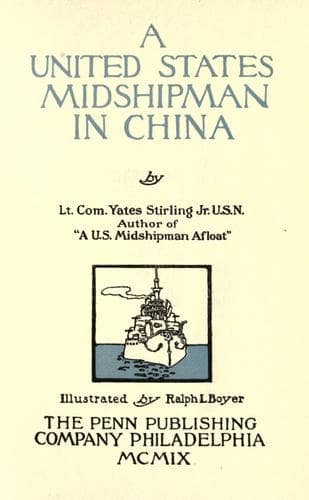
A United States Midshipman in ChinaStirling, Yates
General
A United States Midshipman in China
Stirling, Yates
China -- Juvenile fiction; United States. Navy -- Juvenile fiction
Commander Hughes’ plans were agreed upon, though not until after much
opposition by the other members of the council, and word was at once
despatched to the foreign merchants and consuls ashore to close their
stores and houses and seek protection on board the gunboats of their
respective nationalities.
Inside of three hours all preparations were completed and the
international fleet weighed anchor and, in column, the “Phœnix”
leading, steamed boldly down the river.
Langdon had gone to the gunboat’s bridge to pilot the fleet through
the narrow and dangerous channel leading into the shallow waters of
the To-Yan Lake, leaving Phil and Sydney at their guns, aft on the
quarter-deck of the vessel; for all the gunboats had cleared for action
to be prepared in case the Chinese should precipitate hostilities.
While the fleet was getting its anchors up from the bottom of the
muddy river, they gazed with rising pulse at the unusual activity
inside the Chinese batteries; they could see groups of blue-clad
soldiers surrounding the big guns in their rocky emplacements. Would
the forts open fire upon the allied fleet as it steamed past?
The midshipmen knew that if one shot was fired from that impregnable
fortress at the miniature battle-ships the sound would travel around
the world. It would mean war! The forts belonged to the Chinese
government and were manned by her soldiers; no idle excuse would be
accepted by the nations insulted.
“These ships wouldn’t stand a ghost of a chance against those guns,”
Sydney exclaimed nervously as he joined Phil on his side of the deck.
The sailors stood silently at their batteries, each gun loaded with
high explosive shell and ready to hurl its charge at the enemy at close
range if it should suddenly declare war.
“It’s pretty short range,” Phil declared, “and our gun pointers could
send every shell through those rock gun ports. A fleet of our gunboats
would drive the Chinese gunners from their guns.”
“One Chinese shell, though, would sink us,” Sydney returned, intent
upon gaining his point. “However, let them go ahead. Those rascals will
find the ‘Phœnix’ will give them a surprise-party.”
“The monitors are what we need,” Phil exclaimed, “but they are over a
thousand miles away, broiling in the heat of Manila. With the monitors
here the forts could be silenced and captured by the fleet.”
The long column of moving gunboats was now stretched along the river
from Ku-Ling to the southward. The leader had now safely passed the
forts and its bow was directed down the river for the entrance of the
To-Yan Lake, a good six miles distant.
It was with a feeling of relief that the midshipmen saw the last
gunboat in column, following the “Phœnix’s” lead, pass out of range
of the fort’s guns. It showed that China, as a nation, had not as yet
openly challenged the world to battle; but if those in the forts had
known of the avowed intentions of the fleet might they not have acted
differently?
Public-domain text, read in full here on John Shaqi.
Reviews
Reviews
No reviews yet
Be the first to share your thoughts on this work.
Join the Discussion
Join the discussion
Sign in to leave a comment or review.
Sign InorCreate an account