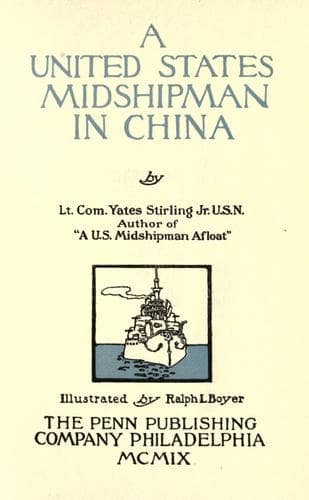
A United States Midshipman in ChinaStirling, Yates
General
A United States Midshipman in China
Stirling, Yates
China -- Juvenile fiction; United States. Navy -- Juvenile fiction
“I impressed upon him that if he did not tell me the truth that I would
kill him,” the pilot exclaimed hurriedly; “he sticks to his story that
to-night they are going to attack the big mission on the graveyard
hills.”
“We’ve but half succeeded,” Commander Hughes exclaimed, the lines in
his face growing deeper from anxiety. “We’ve scattered the outlaws here
with heavy loss,” the dead bodies almost filling the deep trenches
speaking eloquently that fact, “but we must push forward at once to
relieve our mission. I cannot sleep another night until those innocent
non-combatants have been rescued. My men are even secondary,” he added
forcefully; “it is their duty and privilege to die in the cause of
humanity.”
“We cannot hope to succeed without opposition,” Langdon said; “but
before the news of our fight here arouses the viceroy to action against
us, we should relieve the mission, bringing everybody here where we
can protect them. It is but a two-hour march and is but the natural
sequence to the attack we have made.”
“Quite so,” Commander Hughes agreed hopefully. “Langdon,” he added in
a sad voice, “you don’t know what it is to rule a dozen different
nationalities. It is a wonder we can accomplish anything.” Then he
turned to Phil, who had listened eagerly, his young face full of
concern. “Recall the sailors,” he ordered.
After the men had been ordered back from their excited pursuit of the
fleeing Chinese and had fallen into military order in rear of the
captured trenches, the American commander gathered the senior officers
of each nationality about him to urge upon them the necessity of prompt
action to relieve the threatened mission.
Phil started, the hot blood suffusing his face, as he saw with sinking
heart the rank of the foreigner whom he had humiliated before his own
men. Three heavy gold stripes on the officer’s sleeve told him the rank
was that of commander, equal to that of his own captain. This cowardly
officer was then in command of one of the foreign gunboats, but why
had he not seen him before at the councils of the allies on board the
“Phœnix”? Was this Captain Ignacio of the “Albaque,” who had each time
pleaded sickness and sent a young officer to represent him?
Public-domain text, read in full here on John Shaqi.
Reviews
Reviews
No reviews yet
Be the first to share your thoughts on this work.
Join the Discussion
Join the discussion
Sign in to leave a comment or review.
Sign InorCreate an account