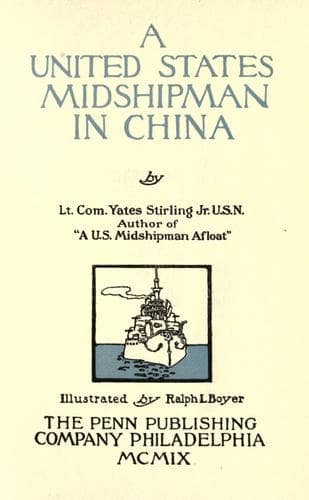
A United States Midshipman in ChinaStirling, Yates
General
A United States Midshipman in China
Stirling, Yates
China -- Juvenile fiction; United States. Navy -- Juvenile fiction
The pilot, after a motion of consent had been received from the leader,
informed the mandarin of Commander Hughes’ terms. Phil watched his
friend’s face closely, glancing occasionally at the dignified old
Chinaman, whom nothing apparently could move.
“There is a hostile movement against the foreigners in your provinces,”
Langdon commenced in the mandarin’s language, using all the flowery
and diplomatic terms which these astute diplomats clung to so closely.
“This movement can exist only through your tolerance. We do not claim
that your Excellency is giving it active support, but you are taking
no steps to smother it. That being the case, the allied powers have
taken the law in their own hands. Having discovered that an army of
rebels were concentrating at Lien-Chow, only seven miles from your
Excellency’s city, with the avowed intention of attacking the American
mission and massacring the inmates, the allies have but a few hours ago
attacked them in their stronghold and dispersed them with many killed,
while not a foreigner has been hurt. These rebels were permitted
to collect despite the fact that you have seven thousand soldiers
under your orders capable of suppressing these outlaws. Commander
Hughes has directed us to say that if your Excellency will give his
honorable word upon the spirit of his father that no further outrages
will be permitted, and that he will protect with his soldiers the
American mission, and also cause to be issued and posted throughout
the provinces orders to desist from attacks on Christian converts and
their teachers, then the foreign sailors will be at once withdrawn from
China’s soil.”
Chang-Li-Hun’s face was barren of expression while the pilot was
delivering himself of this long speech.
“I am not the general of the soldiers,” he craftily replied; “suppose
I, a civilian, should give the soldiers orders to protect foreigners,
how may I be assured that they will obey?”
Langdon fearlessly gazed at the aged mandarin, whom he knew was trying,
as the Chinese say, “to throw dust in his eyes.”
“Is not the Tartar general under the orders of the viceroy?” he asked
uncompromisingly.
“I may give an order,” the viceroy answered evasively, “but I am not a
soldier; then how shall I risk the displeasure of my father’s spirit,
when I would not know if it were being enforced?”
By the viceroy’s words his treachery was unmasked. Langdon had been
told in the strictest confidence by Emmons that General Hang-Ki
had embraced secretly the Christian belief; not suspecting this,
the viceroy had put his foot into a trap by insinuating that the
general could not be depended upon to carry out orders to protect the
foreigners and the thousands of Christian Chinese, who were alike
called foreigners by the fanatical anti-Christians.
“Where can the general be found?” Langdon inquired finally.
“His residence is in the forts,” the viceroy answered.
Public-domain text, read in full here on John Shaqi.
Reviews
Reviews
No reviews yet
Be the first to share your thoughts on this work.
Join the Discussion
Join the discussion
Sign in to leave a comment or review.
Sign InorCreate an account