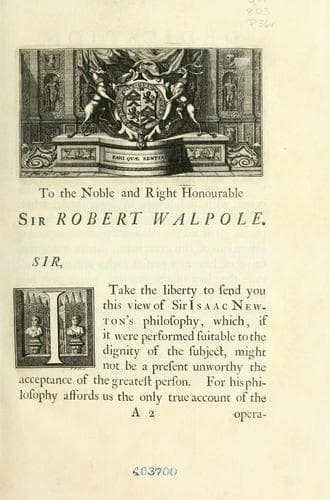
A View of Sir Isaac Newton's PhilosophyPemberton, Henry
Science
A View of Sir Isaac Newton's Philosophy
Pemberton, Henry
Newton, Isaac, 1642-1727. Principia
93. THUS I have recounted the principal discoveries, which had been
made concerning the motion of bodies by Sir ~ISAAC NEWTON~’S
predecessors; all these discoveries, by being found to agree with
experience, contributing to establish the laws of motion, from whence
they were deduced. I shall therefore here finish what I had to say
upon those laws; and conclude this chapter with a few words concerning
the distinction which ought to be made between absolute and relative
motion. For some have thought fit to confound them together; because
they observe the laws of motion to take place here on the earth, which
is in motion, after the same manner as if it were at rest. But Sir
~ISAAC NEWTON~ has been careful to distinguish between the
relative and absolute consideration both of motion and time[76]. The
astronomers anciently found it necessary to make this distinction in
time. Time considered in it self passes on equably without relation to
any thing external, being the proper measure of the continuance and
duration of all things. But it is most frequently conceived of by us
under a relative view to some succession in sensible things, of which
we take cognizance. The succession of the thoughts in our own minds
is that, from whence we receive our first idea of time, but is a very
uncertain measure thereof; for the thoughts of some men flow on much
more swiftly, than the thoughts of others; nor does the same person
think equally quick at all times. The motions of the heavenly bodies
are more regular; and the eminent division of time into night and day,
made by the sun, leads us to measure our time by the motion of that
luminary: nor do we in the affairs of life concern our selves with any
inequality, which there may be in that motion; but the space of time
which comprehends a day and night is rather supposed to be always the
same. However astronomers anciently found these spaces of time not to
be always of the same length, and have taught how to compute their
differences. Now the time, when so equated as to be rendered perfectly
equal, is the true measure of duration, the other not. And therefore
this latter, which is absolutely true time, differs from the other,
which is only apparent. And as we ordinarily make no distinction
between apparent time, as measured by the sun, and the true; so we
often do not distinguish in our usual discourse between the real, and
the apparent or relative motion of bodies; but use the same words for
one, as we should for the other. Though all things about us are really
in motion with the earth; as this motion is not visible, we speak of
the motion of every thing we see, as if our selves and the earth stood
still. And even in other cases, where we discern the motion of bodies,
we often speak of them not in relation to the whole motion we see, but
with regard to other bodies, to which they are contiguous. If any body
were lying on a table; when that table shall be carried along, we say
Public-domain text, read in full here on John Shaqi.
Reviews
Reviews
No reviews yet
Be the first to share your thoughts on this work.
Elsewhere in the archive
Join the Discussion
Join the discussion
Sign in to leave a comment or review.
Sign InorCreate an account