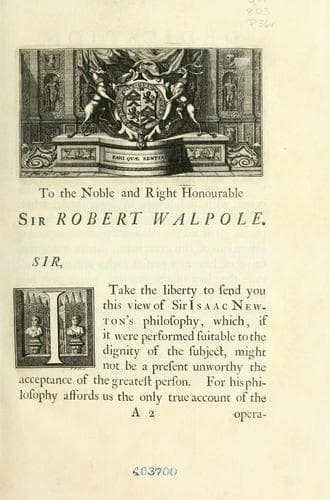
A View of Sir Isaac Newton's PhilosophyPemberton, Henry
Science
A View of Sir Isaac Newton's Philosophy
Pemberton, Henry
Newton, Isaac, 1642-1727. Principia
the body rests upon the table, or perhaps absolutely, that the body is
at rest. However philosophers must not reject all distinction between
true and apparent motions, any more than astronomers do the distinction
between true and vulgar time; for there is as real a difference between
them, as will appear by the following consideration. Suppose all the
bodies of the universe to have their courses stopped, and reduced to
perfect rest. Then suppose their present motions to be again restored;
this cannot be done without an actual impression made upon some of them
at least. If any of them be left untouched, they will retain their
former state, that is, still remain at rest; but the other bodies,
which are wrought upon, will have changed their former state of rest,
for the contrary state of motion. Let us now suppose the bodies left
at rest to be annihilated, this will make no alteration in the state
of the moving bodies; but the effect of the impression, which was made
upon them, will still subsist. This shews the motion they received to
be an absolute thing, and to have no necessary dependence upon the
relation which the body said to be in motion has to any other body[77].
94. BESIDES absolute and relative motion are distinguishable by their
Effects. One effect of motion is, that bodies, when moved round any
center or axis, acquire a certain power, by which they forcibly
press themselves from that center or axis of motion. As when a body
is whirled about in a sling, the body presses against the sling, and
is ready to fly out as soon as liberty is given it. And this power
is proportional to the true, not relative motion of the body round
such a center or axis. Of this Sir ~ISAAC NEWTON~ gives the following
instance[78]. If a pail or such like vessel near full of water be
suspended by a string of sufficient length, and be turned about till
the string be hard twisted. If then as soon as the vessel and water
in it are become still and at rest, the vessel be nimbly turned about
the contrary way the string was twisted, the vessel by the strings
untwisting it self shall continue its motion a long time. And when the
vessel first begins to turn, the water in it shall receive little or
nothing of the motion of the vessel, but by degrees shall receive a
communication of motion, till at last it shall move round as swiftly
as the vessel it self. Now the definition of motion, which ~DES
CARTES~ has given us upon this principle of making all motion
meerly relative, is this: that motion, is a removal of any body from
its vicinity to other bodies, which were in immediate contact with
it, and are considered as at rest[79]. And if this be compared with
what he soon after says, that there is nothing real or positive in the
body moved, for the sake of which we ascribe motion to it, which is
not to be found as well in the contiguous bodies, which are considered
as at rest[80]; it will follow from thence, that we may consider the
Public-domain text, read in full here on John Shaqi.
Reviews
Reviews
No reviews yet
Be the first to share your thoughts on this work.
Elsewhere in the archive
Join the Discussion
Join the discussion
Sign in to leave a comment or review.
Sign InorCreate an account