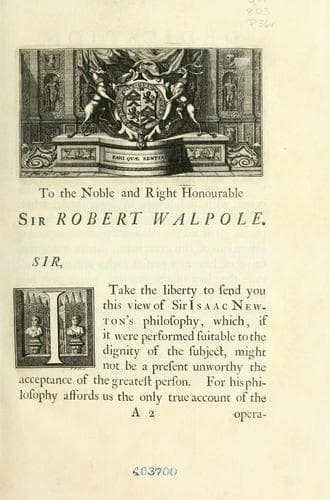
A View of Sir Isaac Newton's PhilosophyPemberton, Henry
Science
A View of Sir Isaac Newton's Philosophy
Pemberton, Henry
Newton, Isaac, 1642-1727. Principia
2. THE first thing demonstrated of these secondary planets is, that
they are drawn towards their respective primary in the same manner
as the primary planets are attracted by the sun. That each secondary
planet is kept in its orbit by a power pointed towards the center of
the primary planet, about which the secondary revolves; and that the
power, by which the secondaries of the same primary are influenced,
bears the same relation to the distance from the primary, as the power,
by which the primary planets are guided, does in regard to the distance
from the sun[172]. This is proved in the satellites of Jupiter and
Saturn, because they move in circles, as far as we can observe, about
their respective primary with an equable course, the respective primary
being the center of each orbit: and by comparing the times, in which
the different satellites of the same primary perform their periods,
they are found to observe the same relation to the distances from
their primary, as the primary planets observe in respect of their mean
distances from the sun[173]. Here these bodies moving in circles with
an equable motion, each satellite passes over equal parts of its orbit
in equal portions of time; consequently the line drawn from the center
of the orbit, that is, from the primary planet, to the satellite, will
pass over equal spaces along with the satellite in equal portions of
time; which proves the power, by which each satellite is held in its
orbit, to be pointed towards the primary as a center[174]. It is also
manifest that the centripetal power, which carries a body in a circle
concentrical with the power, acts upon the body at all times with the
same strength. But Sir ~ISAAC NEWTON~ demonstrates that, when
bodies are carried in different circles by centripetal powers directed
to the centers of those circles, then, the degrees of strength of
those powers are to be compared by considering the relation between
the times, in which the bodies perform their periods through those
circles[175]; and in particular he shews, that if the periodical times
bear that relation, which I have just now asserted the satellites
of the same primary to observe; then the centripetal powers are
reciprocally in the duplicate proportion of the semidiameters of the
circles, or in that proportion to the distances of the bodies from the
centers[176]. Hence it follows that in the planets Jupiter and Saturn,
the centripetal power in each decreases with the increase of distance,
in the same proportion as the centripetal power appertaining to the
sun decreases with the increase of distance. I do not here mean that
this proportion of the centripetal powers holds between the power of
Jupiter at any distance compared with the power of Saturn at any other
distance; but only in the change of strength of the power belonging to
the same planet at different distances from him. Moreover what is here
discovered of the planets Jupiter and Saturn by means of the different
Public-domain text, read in full here on John Shaqi.
Reviews
Reviews
No reviews yet
Be the first to share your thoughts on this work.
Elsewhere in the archive
Join the Discussion
Join the discussion
Sign in to leave a comment or review.
Sign InorCreate an account