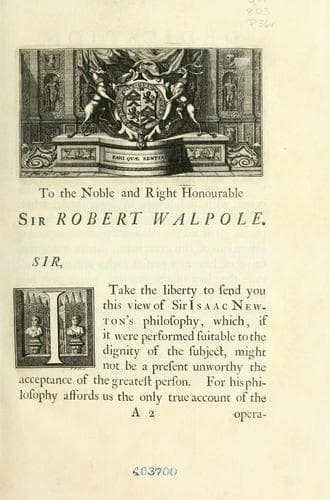
A View of Sir Isaac Newton's PhilosophyPemberton, Henry
Science
A View of Sir Isaac Newton's Philosophy
Pemberton, Henry
Newton, Isaac, 1642-1727. Principia
11. UPON this head I think it not improper to mention a reflection made
by our excellent author upon these small inequalities in the planets
motions; which contains under it a very strong philosophical argument
against the eternity of the world. It is this, that these inequalities
must continually increase by slow degrees, till they render at length
the present frame of nature unfit for the purposes, it now serves[171].
And a more convincing proof cannot be desired against the present
constitution’s having existed from eternity than this, that a certain
period of years will bring it to an end. I am aware this thought of
our author has been represented even as impious, and as no less than
casting a reflection upon the wisdom of the author of nature, for
framing a perishable work. But I think so bold an assertion ought to
have been made with singular caution. For if this remark upon the
increasing irregularities of the heavenly motions be true in fact,
as it really is, the imputation must return upon the asserter, that
this does detract from the divine wisdom. Certainly we cannot pretend
to know all the omniscient Creator’s purposes in making this world,
and therefore cannot undertake to determine how long he designed it
should last. And it is sufficient, if it endure the time intended by
the author. The body of every animal shews the unlimited wisdom of its
author no less, nay in many respects more, than the larger frame of
nature; and yet we see, they are all designed to last but a small space
of time.
12. THERE need nothing more be said of the primary planets; the motions
of the secondary shall be next considered.
CHAP. III.
Of the motion of the MOON and the other SECONDARY PLANETS.
THE excellency of this philosophy sufficiently appears from its
extending in the manner, which has been related, to the minutest
circumstances of the primary planets motions; which nevertheless
bears no proportion to the vast success of it in the motions of the
secondary; for it not only accounts for all the irregularities, by
which their motions were known to be disturbed, but has discovered
others so complicated, that astronomers were never able to distinguish
them, and reduce them under proper heads; but these were only to be
found out from their causes, which this philosophy has brought to
light, and has shewn the dependence of these inequalities upon such
causes in so perfect a manner, that we not only learn from thence in
general, what those inequalities are, but are able to compute the
degree of them. Of this Sir ~IS. NEWTON~ has given several
specimens, and has moreover found means to reduce the moon’s motion so
completely to rule, that he has framed a theory, from which the place
of that planet may at all times be computed, very nearly or altogether
as exactly, as the places of the primary planets themselves, which is
much beyond what the greatest astronomers could ever effect.
Public-domain text, read in full here on John Shaqi.
Reviews
Reviews
No reviews yet
Be the first to share your thoughts on this work.
Elsewhere in the archive
Join the Discussion
Join the discussion
Sign in to leave a comment or review.
Sign InorCreate an account