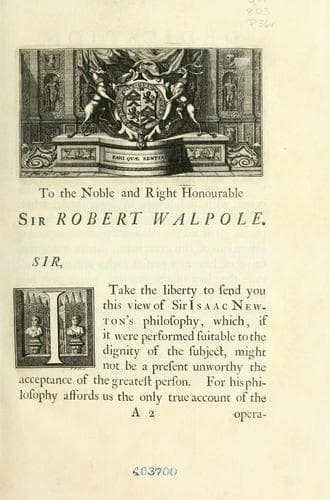
A View of Sir Isaac Newton's PhilosophyPemberton, Henry
Science
A View of Sir Isaac Newton's Philosophy
Pemberton, Henry
Newton, Isaac, 1642-1727. Principia
turned slowly about, while the boards and prism N O P remain fixed,
in a little time another colour will fall upon the hole L, which, if
the prism N O P were taken away, would proceed like the former rays
to the same point W; but the refraction of the prism N O P shall not
carry these rays to _s_, but to some place less distant from W as to
_t_. Suppose now the rays which go to _t_ to be the indigo-making rays.
It is manifest that the boards A B, C D, and prism N O P remaining
immoveable, both the violet-making and indigo-making rays are incident
alike upon the prism N O P, for they are equally inclined to its
surface O P, and enter it in the same part of that surface; which shews
that the indigo-making rays are less diverted out of their course by
the refraction of the prism, than the violet-making rays under an
exact parity of all circumstances. Farther, if the prism G H I be more
turned about, ’till the blue-making rays pass through the hole L, these
shall fall upon the surface Q R below I, as at _v_, and therefore are
subjected to a less refraction than the indigo-making rays. And thus
by proceeding it will be found that the green-making rays are less
refracted than the blue-making rays, and so of the rest, according to
the order in which they lie in the coloured spectrum.
4. THIS disposition of the different coloured rays to be refracted
some more than others our author calls their respective degrees of
refrangibility. And since this difference of refrangibility discovers
it self to be so regular, the next step is to find the rule it observes.
Public-domain text, read in full here on John Shaqi.
Reviews
Reviews
No reviews yet
Be the first to share your thoughts on this work.
Elsewhere in the archive
Join the Discussion
Join the discussion
Sign in to leave a comment or review.
Sign InorCreate an account