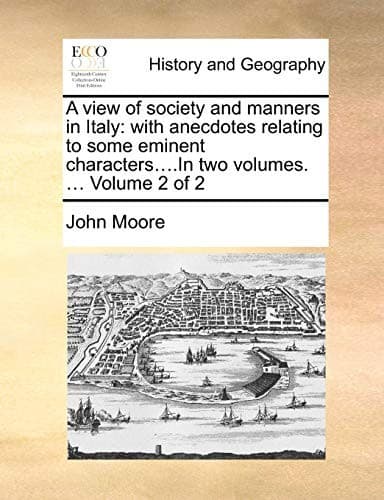
A View of Society and Manners in Italy, Volume 2 (of 2): With Anecdotes Relating to some Eminent CharactersMoore, John
History
A View of Society and Manners in Italy, Volume 2 (of 2): With Anecdotes Relating to some Eminent Characters
Moore, John
Italy -- Description and travel -- Early works to 1800; Italy -- Social life and customs -- Early works to 1800
Notwithstanding the fertility of the country around it, the town of
Placentia itself is but thinly inhabited, and seems to be in a state
of decay. What first strike a stranger on entering this city, are two
equestrian statues, in bronze, by Giovanni di Bologna; they stand in the
principal square, before the Town-house. The best of the two represents
that consummate general Alexander Farnese, Duke of Parma and Placentia,
who commanded the army of Philip II. in the Netherlands. The inscription
on the pedestal mentions his having relieved the city of Paris, when
called to the assistance of the League into France, where his great
military skill, and cool intrepidity, enabled him to baffle all the
ardent impetuosity of the gallant Henry. He was certainly worthy of a
better master, and of serving in a better cause. We cannot, without
regret, behold a Prince, of the Duke of Parma’s talents and character,
supporting the pride of an unrelenting tyrant, and the rancour of furious
fanatics.
Except the Ducal Palace, and some pictures in the churches, which I dare
swear you will cordially forgive me for passing over undescribed, I
believe there is not a great deal in this city worthy of attention; at
all events I can say little about them, as we remained here only a few
hours during the heat of the day, and set out the same evening for Milan.
LETTER LXXVIII.
Milan.
Milan, the ancient capital of Lombardy, is the largest city in Italy,
except Rome; but though it is thought rather to exceed Naples in size, it
does not contain above one-half the number of inhabitants.
The cathedral stands in the centre of the city, and, after St. Peter’s,
is the most considerable building in Italy. It ought by this time to
be the largest in the world, if what they tell us be true, that it is
near four hundred years since it was begun, and that there has been a
considerable number of men daily employed in completing it ever since;
but as the injuries which time does to the ancient parts of the fabric
keep them in constant employment, without the possibility of their work
being ever completed, Martial’s epigram, on the barber Eutrapelus, has
been applied to them with great propriety. That poor man, it seems,
performed his operations so very slowly, that the beards of his patients
required shaving again on the side where he had begun, by the time he had
finished the other.
EUTRAPELUS TONSOR DUM CIRCUIT ORA LUPERCI,
EXPUNGITQUE GENAS, ALTERA BARBA SUBIT.
Public-domain text, read in full here on John Shaqi.
Reviews
Reviews
No reviews yet
Be the first to share your thoughts on this work.
Elsewhere in the archive
Join the Discussion
Join the discussion
Sign in to leave a comment or review.
Sign InorCreate an account