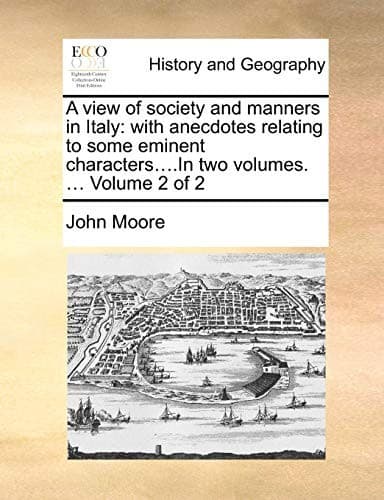
A View of Society and Manners in Italy, Volume 2 (of 2): With Anecdotes Relating to some Eminent CharactersMoore, John
History
A View of Society and Manners in Italy, Volume 2 (of 2): With Anecdotes Relating to some Eminent Characters
Moore, John
Italy -- Description and travel -- Early works to 1800; Italy -- Social life and customs -- Early works to 1800
The Italians, in general, very seldom take the trouble of sitting
for their pictures. They consider a portrait as a piece of painting,
which engages the admiration of nobody but the person it represents,
or the painter who drew it. Those who are in circumstances to pay the
best artists, generally employ them in some subject more universally
interesting, than the representation of human countenances staring out of
a piece of canvas.
Pompeio Battoni is the best Italian painter now at Rome. His taste and
genius led him to history painting, and his reputation was originally
acquired in that line; but by far the greater part of his fortune,
whatever that may be, has flowed through a different channel. His chief
employment, for many years past, has been painting the portraits of the
young English, and other strangers of fortune, who visit Rome. There are
artists in England, superior in this, and every other branch of painting,
to Battoni. They, like him, are seduced from the free walks of genius,
and chained, by interest, to the servile drudgery of copying faces.
Beauty is worthy of the most delicate pencil; but, gracious heaven! why
should every periwig-pated fellow, without countenance or character,
insist on seeing his chubby cheeks on canvas?
“Could you not give a little expression to that countenance?” said a
gentleman to an eminent English painter, who showed him a portrait which
he had just finished. “I made that attempt already,” replied the painter;
“but what the picture gained in expression, it lost in likeness; and by
the time there was a little common sense in the countenance, nobody knew
for whom it was intended. I was obliged, therefore, to make an entire new
picture, with the face perfectly like, and perfectly meaningless, as you
see it.”
Let the colours for ever remain, which record the last fainting efforts
of Chatham; the expiring triumph of Wolf; or the indecision of Garrick,
equally allured by the two contending Muses! But let them perish and
fly from the canvas, which blind self-love spreads for insipidity and
ugliness! Why should posterity know, that the first genius of the age,
and those whose pencils were formed to speak to the heart, and delineate
beauteous Nature, were chiefly employed in copying faces? and many of
them, faces that imitate humanity so abominably, that, to use Hamlet’s
expression, they seem not the genuine work of Nature, but of Nature’s
journeymen.
Public-domain text, read in full here on John Shaqi.
Reviews
Reviews
No reviews yet
Be the first to share your thoughts on this work.
Join the Discussion
Join the discussion
Sign in to leave a comment or review.
Sign InorCreate an account