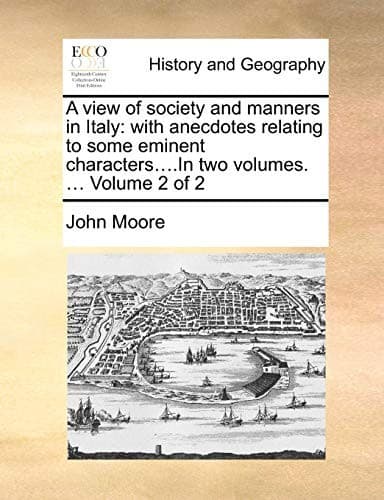
A View of Society and Manners in Italy, Volume 2 (of 2): With Anecdotes Relating to some Eminent CharactersMoore, John
History
A View of Society and Manners in Italy, Volume 2 (of 2): With Anecdotes Relating to some Eminent Characters
Moore, John
Italy -- Description and travel -- Early works to 1800; Italy -- Social life and customs -- Early works to 1800
Keysler and some others say, that Appius made this road at his own
expence. I do not know on what authority they make this assertion; but,
whatever their authority may be, the thing is incredible. Could a Roman
citizen, at a period when the inhabitants of Rome were not rich, bear an
expence which we are surprised that even the State itself could support?
Though this famous road has received its name from Appius, I can hardly
imagine it was completed by him. The distance from Rome to Capua is above
one hundred and thirty miles; a prodigious length for such a road as this
to have been made, during the short course of one Censorship; for a man
could be Censor only once in his life. This was an office of very great
dignity; no person could enjoy it till he had previously been Consul. It
was originally held for five years; but, a hundred years before the time
of Appius, the term was abridged to eighteen months. He, however, who,
as Livy tells us, possessed all the pride and obstinacy of his family,
refused to quit the Censorship at the end of that period; and, in spite
of all the efforts of the Tribunes, continued three years and a half
beyond the term to which the office had been restricted by the Æmilian
Law. But even five years is a very short time for so great a work; yet
this was not the only work he carried on during his Censorship. “Viam
munivit,” says the Historian, “et aquam in urbem duxit.” The Appian road
was carried on, afterwards, from Capua to Brundusium, and was probably
completed so far, in the time of Horace; as appears by this verse, in one
of his Epistles addressed to Lollius:
Brundusium Numici melius via ducat, an Appi.
Terracina is the last town of the Ecclesiastical, and Fundi the first of
the Neapolitan, dominions. This last town stands on a plain, sheltered by
hills, which is seldom the case with Italian towns: it probably derives
its name from its situation. There is nothing very attractive in this
place, now, more than in Horace’s time; so we left it as willingly as he
did:
Fundos Aufidio Lusco Prætore _libenter_ Linquimus.
Continuing our route, partly on the Appian way, we came to Mola di Gaeta,
a town built on the ruins of the ancient Formiæ. Horace compliments Ælius
Lamia, on his being descended from the first founder of this city:
Auctore ab illo ducis originem,
Qui Formiarum mœnia dicitur,
Princeps.
The same Poet puts the wine, made from the grapes of the Formian hills,
on a footing with the Falernian:
——mea nec Falernæ
Temperant vites, neque Formiani
Pocula colles.
Public-domain text, read in full here on John Shaqi.
Reviews
Reviews
No reviews yet
Be the first to share your thoughts on this work.
Join the Discussion
Join the discussion
Sign in to leave a comment or review.
Sign InorCreate an account