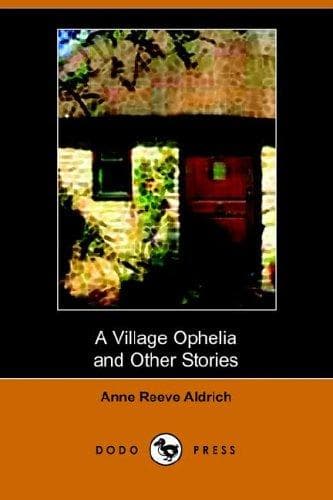
A Village Ophelia, and Other StoriesAldrich, Anne Reeve
General
A Village Ophelia, and Other Stories
Aldrich, Anne Reeve
American fiction -- 19th century; Short stories, American
I looked up to the
deep, cloudless sky, around at the wide stretch of green in the golden
sunlight, then almost unconsciously back once more to the edge of the
woods, where the spread rugs made a tiny home fit for the heart of
summertide. Nor did I guess, even then, which was the dominant note of
this wonderful chord that my life had unconsciously struck. I knew only
that the world was far more beautiful than I had ever dreamed, and still
singing under my breath the little cadence that seemed to fit the day, I
wandered slowly back, leaving a path crushed between the tall, sun-faded
grasses as I went.
Mr. Longworth laid down his work as I approached. A strange, absurd
shyness possessed me, after the weeks of strengthening friendship and
simple good-fellowship, but I held out the great bunch of daisies
playfully to him, as I seated myself on the pile of rugs. He reached
his hand for them eagerly, and buried his face in their sunny depths.
His eyes shone feverishly with his stress of work, and his thin cheeks
were flushed. "You look tired," I said. "You should not write so long."
Thus far, though we had often jested about it, we had never read each
other portions of our work.
"When I get mine half done," I had said, when he begged me to read him a
chapter.
"When I can manage to make a chapter run smoothly to its end," he had
replied laughing, in turn, but now to-day, urged by some necessity for
an absorbing topic into which I could plunge, losing my restlessness, I
insisted that he should read fragments, at least, to me.
He demurred at first. "I have told you how stupid it sounds, these
disconnected bits, little descriptions, detached conversations.
Sometimes I think I shall never use them after all." He fingered the
pages absently.
"No, read it to me as it is," I begged. "I must hear it. I understand,
of course, how it is written."
And so, yielding to my entreaties, he read, while I leaned back against
the tree trunk, listening at first critically, and interested, perhaps,
because it was his work, then with clasped hands and shortening breath,
leaning forward that I might lose no word. A little squirrel scampered
through the undergrowth back of us, and far in another field I could
hear Mr. Hopper's quavering voice, as he called to the haymakers.
Sometimes a leaf rustled, falling to the ground, but it was very quiet.
At last he laid down the leaves, and fixed his dark eyes eagerly on my
face, as if he would read my thoughts, but my eyes were full of tears,
and they were selfish tears. "My poor book!" I said, with a tender
contempt for it.
"Do you mean--?" he began increduously.
Public-domain text, read in full here on John Shaqi.
Reviews
Reviews
No reviews yet
Be the first to share your thoughts on this work.
Join the Discussion
Join the discussion
Sign in to leave a comment or review.
Sign InorCreate an account