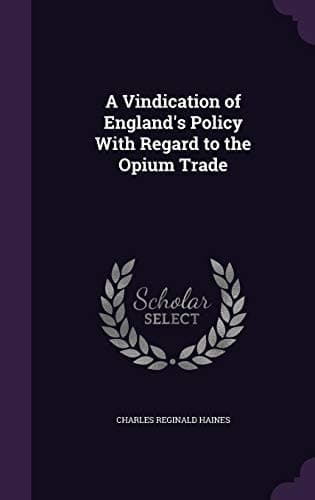
A Vindication of England's Policy with Regard to the Opium TradeHaines, Charles Reginald
History
A Vindication of England's Policy with Regard to the Opium Trade
Haines, Charles Reginald
Opium trade
be disguised, from the Emperor, was the inability of the Chinese to
prevent opium from entering the rivers and harbours of the empire, or from
being consumed by their subjects. The Chinese Commissioner tried to throw
the blame on the British Government, asserting that _they_ should enforce
the prohibition and prevent their subjects from engaging in the trade, a
position tenable on no principle of international obligations.[21] The
Chinese, then, were unable to stop the traffic and unwilling to legalize
it. The mandarins were driven to all kinds of desperate shifts to cloak
their imbecility; and Sir H. Pottinger, in one of his last despatches,
says: "The mandarins openly give out that they dare not stop the traffic,
else it would lead to the cultivation of the poppy in China to so great an
extent as to cause a scarcity of food, if not a famine." A truly
surprising reason!
However, the arguments of successive British Commissioners seem to have
gradually had their effect, and there were not wanting signs that the
Chinese authorities were coming round. They were beginning to see that the
only way to arrest the hæmorrhage of silver, so alarming to them, which in
fifty-four years had amounted to 12,000 tons, was to legalize the traffic
in opium, so that the drug might be exchanged for other commodities,
instead of, as now, being paid for clandestinely in sterling silver. As a
proof that the Chinese were not now in earnest against the traffic, it may
be mentioned that not a single proclamation was issued against it since
the negotiations between Keying and the English Envoy began. Moreover, as
Sir J. Davis wrote to the Earl of Aberdeen, the Chinese did not wish to
abolish the traffic, as the impoverished state of the finances of the
country did not admit of the servants of the Government being adequately
paid in a legitimate manner. So recognized, indeed, had the traffic
become, that legal duties even were often paid in opium.[22] But that the
smuggling and piracy caused by opium being technically a contraband
article were a "womb of evil," was evident to the Chinese themselves, and
also that they might any moment be made the excuse for a raid against the
foreign community (and there was even a report that Seu, the Imperial
Commissioner, was contemplating this), which could only result in a fresh
war. So we find that, in spite of their protestations to the contrary, the
Chinese Commissioners did refer the matter to the Emperor several times,
and on one occasion a decree legalizing the importation was drawn up by
his ministers for the Emperor's approval. When, however, the imperial
pleasure was finally taken, Taou Kwang forbad any further reference to the
proposal, saying that he could not "change face." So the matter rested for
the present. But the advice pressed upon the Emperor that he should
legalize the trade did not come from the British Envoys only; for in the
_Pekin Gazette_ for January 4th, 1853, there appeared a memorial from a
Public-domain text, read in full here on John Shaqi.
Reviews
Reviews
No reviews yet
Be the first to share your thoughts on this work.
Join the Discussion
Join the discussion
Sign in to leave a comment or review.
Sign InorCreate an account