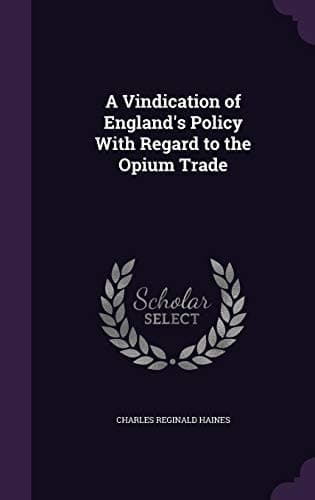
A Vindication of England's Policy with Regard to the Opium Trade — John Shaqi
A Vindication of England's Policy with Regard to the Opium TradeHaines, Charles Reginald
History
A Vindication of England's Policy with Regard to the Opium Trade
Haines, Charles Reginald
Opium trade
All, or all except a few visionary enthusiasts, have
come to see that the only way to check this widespread vice is by bringing
the opinion of the people to bear upon it, to drive it out from among the
lower classes as it has been driven out from the upper by the force of
public example and public opinion. It is obvious that the same reasoning
will apply to China[107], and accordingly we find that the drinking of
samshoo, a deletrious extract from rice, was common among the people, and
all prohibitions were powerless to prevent it till the religious influence
of Buddhism was brought to bear upon it and had great success in
diminishing the vice; so that samshoo-drinking is now comparatively rare
in a great part of China, its place being taken by opium, which is allowed
by Buddhist and Mohammedan laws.
But, say the anti-opiumists, if we have not introduced opium into China,
we have certainly forced it upon the Chinese when they showed a sincere
desire to have none of it; first by a system of armed smuggling; secondly,
by open armed intervention in the wars of 1840 and 1857; and thirdly, by
the imperious logic of Lord Elgin and others. Now, as to the armed
smugglers, the answer is easy. They were armed to resist pirates, who
swarm in the bays and creeks so abundant in the Chinese coast-line of
3,500 miles; and by no means, as implied, to fall foul of the Custom House
officials. These were always amenable enough, and a recognized bribe paid
in due time freed all opium vessels from farther molestation in that
quarter. The second assumption, that the wars were opium wars, false as it
is in reality when thus stated, is a most plausible one; for opium was
certainly the _immediate_ cause of the first war. But it was not the real
cause. European ideas of the equality of nations could not be reconciled
with the insolent pretensions of the Chinese with regard to all
foreigners. This, and much more to the same effect, has already been dwelt
upon in the historical survey, and so need not detain us any longer now.
We may, however, add that no mention whatever of opium was made in the
Nankin Treaty, so that the edicts against the drug remained in force,
though they were no more regarded now than before the war. And this was
certainly not because the Chinese were exhausted by the war and afraid of
a fresh conflict with the English. It is doubtful whether the authorities
at Pekin really considered themselves beaten at all, and the reason why
their edicts were disregarded was not that defeat had weakened the hands
of the executive, but, as before, simply the corruption of the officials,
and the imperious desire of the people for the drug. With regard to the
second war, it is absurd to call that an opium war. Opium had nothing to
do with its commencement, renewal, or end; nor was it even alluded to in
the Treaty of Tientsin. It was only some months after the ratification of
that treaty that in arranging the tariff of imports the Chinese
Public-domain text, read in full here on John Shaqi.
Reviews
Reviews
No reviews yet
Be the first to share your thoughts on this work.
Join the Discussion
Join the discussion
Sign in to leave a comment or review.
Sign InorCreate an account