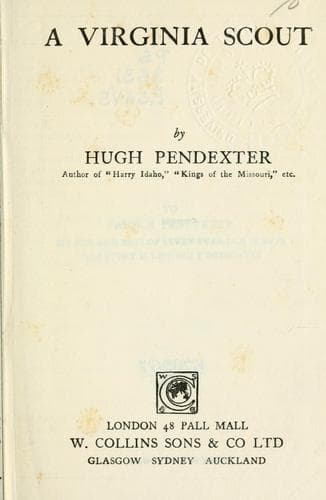
Frontier and pioneer life -- United States -- Fiction; Historical fiction; Lord Dunmore's War, 1774 -- Fiction
Davis, of Howard's Creek, went by me, making for the rear with a shattered
right arm and a ghastly hole through his cheek. He tried to grin on
recognizing me. Word was passed on from our rear that runners had been
sent to hurry up Colonel Christian and his two hundred men. Among the
captains killed by this time were John Murray and Samuel Wilson. It was a
few minutes after the noon hour that Cousin emerged from the smoke on my
right and howled:
"There's old Puck-i-n-shin-wa!"
He darted forward, clearing all obstacles with the ease of a deer. I saw
the Shawnee chief, father of Tecumseh, snap his piece at the boy. Then I
saw him go down with Cousin's lead through his painted head. Two savages
sprang up and Cousin killed one with his remaining barrel. The other fired
pointblank, and by the way Cousin fell I knew his object in wearing the
scarlet jacket was attained. He had wished to die this day in the midst of
battle.
William White killed Cousin's slayer. The boy was in advance of the line
and his coat made him conspicuous. Doubtless the savages believed him to
be an important officer because of it.
Five of them rushed in to secure his scalp, and each fell dead, and their
bodies concealed the boy from view. Up to one o'clock the fighting raged
with undiminished fury, with never any cessation of their taunts and
epithets and Cornstalk's stentorian encouragement.
Now it is never in Indian nature to prolong a conflict once it is obvious
they must suffer heavy losses. They consider it the better wisdom to run
away and await an opportunity when the advantage will be with them.
Cornstalk had been confident that his early morning attack would drive us
into the rivers, thus affording his forces on the opposite banks much
sport in picking us off.
But so fiercely contested had been the battle that none of our dead had
been scalped except Hughey and two or three men who fell at the first
fire. By all that we had learned of Indian nature they should now, after
six hours of continuous fighting, be eager to withdraw. They had fought
the most bitterly contested battle ever participated in by their race.
Nor had they, as in Braddock's defeat, been aided by white men. There
were, to be true, several white men among them, such as Tavenor Ross, John
Ward and George Collet; but these counted no more than ordinary warriors
and Collet was killed before the fighting was half over. According to all
precedents the battle should have ended in an Indian rout by the time the
sun crossed the meridian. Instead the savages stiffened their resistance
and held their line.
Our men cheered from parched throats when word was passed that Collet's
body had been found and identified. Poor devil! Perhaps it opened the long
trace to him, where everything would be made right. He was captured when a
child and had responded to the only environment he had ever known.
Public-domain text, read in full here on John Shaqi.
Reviews
Reviews
No reviews yet
Be the first to share your thoughts on this work.
Elsewhere in the archive
Join the Discussion
Join the discussion
Sign in to leave a comment or review.
Sign InorCreate an account