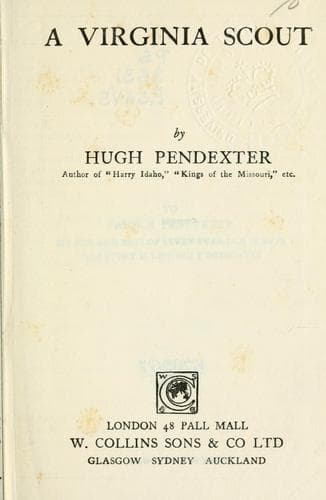
Frontier and pioneer life -- United States -- Fiction; Historical fiction; Lord Dunmore's War, 1774 -- Fiction
The case of such as Collet--yes, and of John Ward and Ross--is entirely
different from that of Timothy Dorman, and others of his kind, who was
captured when a grown man and who turned renegade to revenge himself for
wrongs, real or fancied, on his old neighbors.
It was not until after seven hours of fighting that we detected any
falling off in the enemy's resistance. Even then the savages had the
advantage of an excellent position, and to press them was extremely
hazardous business. We continued to crowd them, however, until they were
lined up on a long ridge which extended from the small marsh where Cousin
and I first saw Robertson and Sevier, for half a mile to the east, where
it was cut by the narrow bed of Crooked Creek.
None of us needed to be told that so long as the enemy held this ridge our
camp at the Point was in grave danger. From the riflemen along the Ohio
word came that the Indians were throwing their dead into the river, while
squaws and boys were dragging back their wounded.
This had a heartening effect on us, for it indicated a doubt was creeping
into the minds of the savages. Once they permitted the possibility of
defeat to possess them their effectiveness would decrease. Company
commanders called on their men to take the ridge, but to keep their line
intact.
With wild cheers the men responded and buckled down to the grueling task.
Every patch of fallen timber proved to be an Indian fort, where the
bravest of the tribes fought until they were killed. It was stubborn
traveling, but our riflemen were not to be denied.
From along the line would come cries of:
"Remember Tygart's Valley!"
"Remember Carr's Creek!"
"Remember the Clendennins!"
And always Cornstalk's voice answered:
"Be strong! Be brave! Fight hard!"
So we struggled up the slope, gaining a yard at a time and counting it a
triumph if we passed a pile of dead timber and gained another a few feet
beyond.
When we were most encouraged the Indians began mocking us and shouting
exultingly and informing us that the warriors across the Kanawha and Ohio
had attacked our camp and were massacring the small force retained there.
This statement, repeatedly hurled at us with every semblance of savage
gloating, tended to weaken the men's one purpose. We could capture the
ridge--but! Behind our determination crawled the fear that we might be
assailed in the rear at any moment.
Captain Shelby was quick to realize the depressing influence of this kind
of talk, and shouted for the word to be passed that it was an Indian
trick, that our troops were guarding the Kanawha for half a mile up the
stream and that the warriors on the Indian shore could not cross over
without the column on our left discovering the move.
Public-domain text, read in full here on John Shaqi.
Reviews
Reviews
No reviews yet
Be the first to share your thoughts on this work.
Elsewhere in the archive
Join the Discussion
Join the discussion
Sign in to leave a comment or review.
Sign InorCreate an account