All three quarters are possessed of a separate beauty. The
elaborately carved pediments and ponderous doors, the heavy
balconies and eaves of the houses, give an old-world quaintness
to the first, which is enhanced by the crowd of many-shaped and
variously coloured boats that line the quays that front the offices on
either side of the Great River. Nothing could be more delightful than
the setting of the red-tiled roofs, with their dragon-decorated ridges
and parapets, on the wooden trellis fronts and canvas blinds of the
Chinese houses. Weltevreden, too, is not without attractions. The broad
porticoes of dazzling white, with their Ionic columns and marble floors,
are often set in a fair surrounding of green trees. The compounds and
gardens are always verdant, and sometimes radiant with bright-leaved
shrubs and flowers. Especially the broad green-covered squares and the
wide roads arched with noble trees speak of coolness and repose in a hot
and weary land. On the outskirts of the town, along the country roads,
where the cocoa palm and banana plantations begin, are the bamboo
cottages of the Sundanese natives.
But it is after nightfall that this place becomes a veritable
fairyland. The open porticoes of the Dutch houses are seen to be
thronged with gaily dressed people, the ladies often still wearing
the sarong, and looking like Æneas' mother--
"Proved to be a goddess by her stately tread,"
and in harmony with the pillars and pediments about them.
Everywhere lights gleam through foliage, and ever and again,
through an air instinct with electric movement and heavy with
perfumes, strains of music reach the ear from the open doorways, or
are wafted in the distance from one of the numerous military bands,
which are ever "discoursing sweet music" to the society of the
capital. In the centre of the town the native streets look, to the
European eye, like a perpetual festival. Outside the doors are
gathered in groups the various inhabitants--Chinese, Malay, or
Sundanese, some clanging cymbals and other strange instruments of
music, others seated round fires, eating baked cakes or fruits and
other frugal dainties. Meanwhile the streets are alive with the
rush of numerous cahars[10] and sadoes, drawn by the agile native
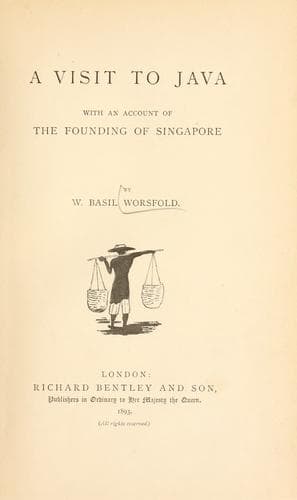
pony, and with itinerant vendors, who, bearing their baskets
suspended from their shoulders by the _pikulan_, or cross-piece,
each with a lamp fixed to the rearmost basket, flit to and fro
noiselessly on their bare feet.
[Footnote 10: Native carriage much like the sadoe, but never
used by Europeans.]
Public-domain text, read in full here on John Shaqi.
Reviews
Reviews
No reviews yet
Be the first to share your thoughts on this work.
Join the Discussion
Join the discussion
Sign in to leave a comment or review.
Sign InorCreate an account