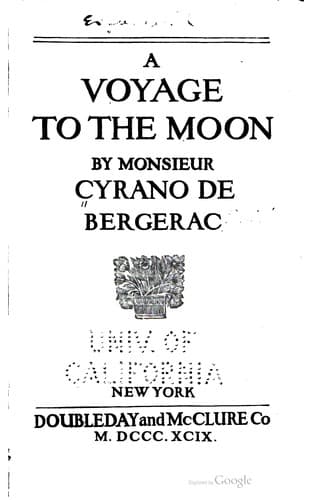
Moon -- Fiction; Science fiction, French -- Translations into English; Space flight to the moon -- Fiction
[11] A famous occult order which probably never existed, but about
which much was written in the first half of the seventeenth century.
It was supposed to have been founded early in the fifteenth century by
Rosenkrenz, a pilgrim who had acquired all the wisdom of the Orient.
[12] Tomaso Campanella, 1568-1639, Italian poet and philosopher, who
came to Paris in 1634. His philosophy was much admired by Cyrano, since
he rejected the Aristotelism of the schools, advocated empiricism
as the only method of arriving at truth, and insisted on the "four
Elements" as the origin of all things.
He appears as an important character in Cyrano's _Voyage to the
Sun_, where he is Cyrano's companion and guide to the Land of the
Philosophers.
[13] Campanella's principal work, published in 1620.
[14] François de La Mothe le Vayer, 1588-1672. He was the tutor of the
Due d'Orléans, brother of Louis XIV., and, after 1654, of Louis XIV.
himself. In philosophy he was a free-thinker, in literature a disciple
of Montaigne. He nevertheless concealed his scepticism in philosophy,
even in his chief work, the _Doutes sceptiques_, under a pretended
orthodoxy in religion, and so was never persecuted. Possibly it is to
this that Cyrano refers in saying, that he "_lived_ as much like a
philosopher, as Gassendi wrote."
[15] _Cf_. p 28, n. 1. (See note 5 chap. III)
[16] _Divine_. The translator has mistaken an adjective for a noun.
[17] François Tristan Thermite, 1601-1655, a French dramatist of
importance. His tragedy of _Mariamne_, in date contemporary with
Corneille's _Cid_, marks him as a predecessor of Racine in method and
manner. He is also the author of fugitive verse, but neither that nor
his plays make him quite worthy of Cyrano's exalted "Elogy."
He was compelled to pass the years 1614-1620 in England, on account of
a duel fought at the age of thirteen!
[18] Talc, silicate of magnesia.
[19] The "Philosopher's Stone," in form of powder, for chemical
"projection" upon baser metals, to transmute them into gold.
[20] The "Elixir of Life," or the "Philosopher's Stone" in liquid form.
[21] _Eulogy_. Still so used at the end of the eighteenth century.
[22] Consequence = _conclusion_, deduction. Cf. Matthew Prior:
"Can syllogisms set things right?
No, majors soon with minors fight.
Or both in friendly consort joined
The consequence limps false behind."
CHAPTER VIII.
_Of the Languages of the People in the Moon; of the Manner of Feeding
there, and Paying the_ Scot; _and of how the Author was taken to Court_.
Public-domain text, read in full here on John Shaqi.
Reviews
Reviews
No reviews yet
Be the first to share your thoughts on this work.
Join the Discussion
Join the discussion
Sign in to leave a comment or review.
Sign InorCreate an account