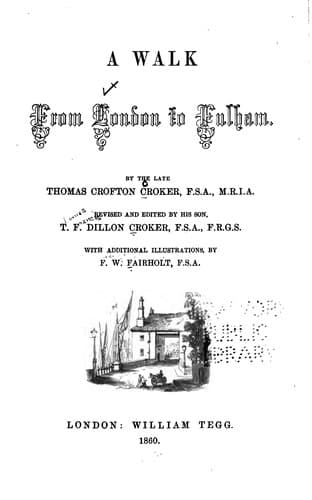
A Walk from London to FulhamCroker, Thomas Crofton
History
A Walk from London to Fulham
Croker, Thomas Crofton
London (England) -- Description and travel
Hook’s furniture was sold by George Robins, in September, 1841. In 1855
the aqueduct was erected by the Chelsea Water Works Company, for
conveying the water from Kingston-upon-Thames to the metropolis, and it
was necessary that the contractor, Mr. Brotherhood, should get possession
of Egmont Villa, to enable them to erect the tower on the Fulham side.
Here the piles and timbers of the old Bishop’s Ferry, used for the
conveyance of passengers across the river from Putney to Fulham, before
the old bridge was built, were discovered. It was subsequently
considered desirable to pull the villa down; and there now remains no
trace of the house in which Hook lived and died, and which stood within a
few paces of his grave. Bowack mentions that Robert Limpany, Esq.,
“whose estate was so considerable in the parish that he was commonly
called the Lord of Fulham,” resided in a neat house in Church Lane. He
died at the age of ninety-four. Beyond the Pryor’s Bank on the right, is
the Bishop’s Walk, which runs along the side of the Thames for some
little distance, and from hence a view of the Bishop’s Palace is
obtained. This palace has been from a very early period the summer
residence of the Bishops of London. The land consists of about 37 acres,
and the whole is surrounded by a moat, over which are two bridges.
Following the course of the Bishop’s Walk, we come to the road leading to
Craven Cottage, originally built by the Margravine of Anspach, when
Countess of Craven, and since altered and improved by Walsh Porter, who
occasionally resided in it till his death in 1809. Craven Cottage was
considered the prettiest specimen of cottage architecture then existing.
The three principal reception-rooms were equally remarkable for their
structure, as well as their furniture. The centre, or principal saloon,
supported by large palm-trees of considerable size, exceedingly well
executed, with their drooping foliage at the top, supporting the cornice
and architraves of the room. The other decorations were in corresponding
taste. The furniture comprised a lion’s skin for a hearth-rug, for a
sofa the back of a tiger, the supports of the tables in most instances
were four twisted serpents or hydras: in fact, the whole of the
decorations of the room were of a character perfectly unique and uniform
in their style. This room led to a large Gothic dining-room of very
considerable dimensions, and on the front of the former apartment was a
very large oval rustic balcony, opposed to which was a large,
half-circular library, that became more celebrated afterwards as the room
in which the highly-gifted and talented author of ‘Pelham’ wrote some of
his most celebrated works.
Craven Cottage was the residence of the Right Hon. Sir E. Bulwer-Lytton,
from whom it passed to Mr. Baylis, now of Thames Bank, who parted with it
to Sir Ralph Howard, its present occupant, who removed the door shown in
the annexed cut, through which the library is seen.
Public-domain text, read in full here on John Shaqi.
Reviews
Reviews
No reviews yet
Be the first to share your thoughts on this work.
Elsewhere in the archive
Join the Discussion
Join the discussion
Sign in to leave a comment or review.
Sign InorCreate an account