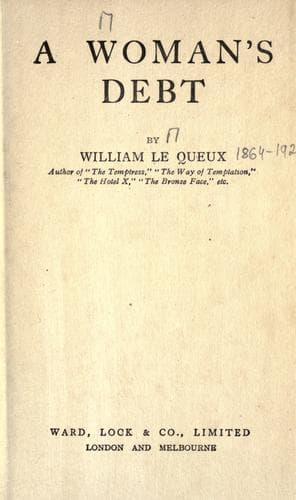
Detective and mystery stories; England -- Social life and customs -- 20th century -- Fiction; English fiction -- 20th century
“And yet Morrice must be a shrewd old bird, or he wouldn’t be where he
is,” observed the detective. “You would think before he married a woman
he would have made exhaustive inquiries about her. Unless, of course,
he does know certain facts, and winks at the nephew business, thinking
it doesn’t concern anybody but themselves. But, of course, I incline
to the belief he doesn’t know. He has the highest reputation for
integrity, and it is more than improbable he would lend his countenance
to such an imposture, even if it were an innocent one, which I very
much doubt.”
“So do I,” agreed Sellars. “Now as soon as I can I will get hold of
this Alma Buckley and see if she knows anything, and if so, if she will
impart it to me. But I am not very hopeful in that quarter. It’s a
deuce of a long time ago, and she may be out of business or dead.”
“If she’s dead, of course we are done. But as long as people are alive
we can generally get at them sooner or later,” said Lane with a knowing
smile.
“I quite agree, they can’t hide themselves for long if one is
sufficiently persevering. Well, now about this Clayton-Brookes. We have
established that he is as queer a fish as Mrs. Morrice; we want to know
a good bit about him, don’t we?”
“What is the general report about him—I mean, of course, amongst the
circles in which he moves?”
Sellars paused a moment or two before he answered. He had heard a good
deal about the man, of course, but up to the present he had not taken
any particular interest in him.
“The general impression is that he is very well-off, not from his
property, because it is well-known that was so heavily encumbered by
his father that it would take more than a lifetime to redeem it. He is
supposed to have come into a fortune from a man named Clayton, whose
name he assumed, either out of compliment or because it was a condition
imposed.”
“Have you ever heard any details of this man Clayton, who was so
obliging as to leave him a fortune?”
Sellars shook his head. “None. You know how easily people swallow a
story when it is properly prepared and ladled out in a circumstantial
way. Clayton may be as much a myth as the nephew for aught we know. You
see how readily that has been accepted. You would say, at first hand,
that a man would be afraid to invent a marriage in his own family; that
there would be dozens of people who knew Archibald Brookes had no wife,
and would come forward and say so.”
“He was helped in that case by the man having cut himself adrift for
so many years, that nobody was likely to know anything about him. But
now concerning this Clayton—if we could get to know who the man was;
there is such a place as Somerset House, there are such things as wills
there. We could soon get what we wanted.”
Public-domain text, read in full here on John Shaqi.
Reviews
Reviews
No reviews yet
Be the first to share your thoughts on this work.
Join the Discussion
Join the discussion
Sign in to leave a comment or review.
Sign InorCreate an account