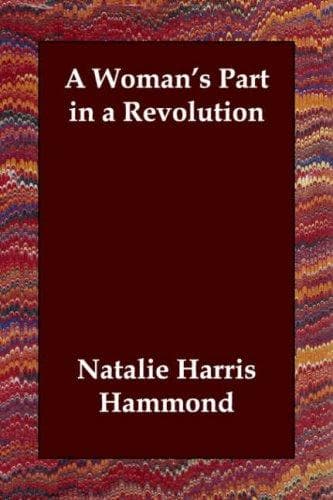
A Woman's Part in a RevolutionHammond, Natalie Harris
History
A Woman's Part in a Revolution
Hammond, Natalie Harris
Jameson's Raid, 1895-1896
The night following the sentence, Mr. Chapin, the U.S. Consul, and his
wife came to me. They were then and for months afterwards as tender
and faithful as people of my own kindred. Mr. Chapin was tireless in
his efforts in behalf of the Americans in trouble, and the high
personal regard in which he was held by the Boer, as well as
Uitlander, did much subsequently to ameliorate their circumstances.
Mr. Chapin at once interviewed Mr. Wessels, chief advocate for the
Reformers--and he told me immediately after the interview the result
of their meeting. Mr. Wessels distinctly said that, although it was
not put in writing, it was understood between the State Attorney and
himself 'as between man and man' that if the prisoners pleaded guilty
he would not press for severe punishment. (Mr. Wessels has since, for
reasons only known to himself, denied this both privately and
publicly.)
APRIL 29.--The commutation was published. Mrs. George Farrar had come
from Johannesburg, and together we went to see our husbands. Our visit
was limited to five minutes. We found the four men haggard, but
apparently cheerful. The condemned cell had an earthen floor. It had
been newly whitewashed and reeked of antiseptics. Four canvas
stretchers, a tin pail filled with water, and a dipper, furnished it.
A negro murderer had been its last occupant. I sat on one of the
canvas cots with an arm around my husband and holding Colonel Rhodes'
hand. Mrs. Farrar was sitting on the opposite cot, locked in her
husband's embrace. The guard came to order us out. Poor Mrs. Farrar
looked so frail and white, I put my arm about her to give her support.
In the courtyard we stopped to speak to one of the Reformers. The
guard became furious, and, swinging his arms in a threatening manner,
rushed at us with curses. We were driven violently out of the yard
like depredating dogs. Surely the sun never looked upon two women in
sadder case. She was just up from her confinement, and I was far
advanced in pregnancy.
XII
No cable of political purport could be sent from Pretoria safe from
mutilation. I therefore despatched Mr. Hammond's secretary to Cape
Town with a message to the American press, reporting Mr. Wessels' plea
for the Reformers, the statement of the four leaders, and the
sentence. I did this, believing that, if the American public fully
understood the circumstances of the case, popular sympathy would allow
no stone to remain unturned to protect their unfortunate countryman
from so violent and unjust a sentence.
Public-domain text, read in full here on John Shaqi.
Reviews
Reviews
No reviews yet
Be the first to share your thoughts on this work.
Join the Discussion
Join the discussion
Sign in to leave a comment or review.
Sign InorCreate an account