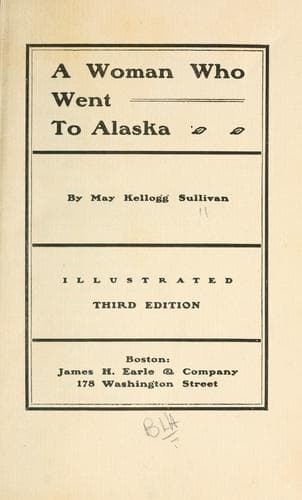
Alaska -- Description and travel; Frontier and pioneer life -- Alaska
One of the first American children to open his eyes to the light of day
in this bleak and barren place--Nome City--was Little Willie S. His
parents lived in a poor board shack or house which his father had built
just back of the golden beach sands. Here the surf, all foam-tipped,
spread itself at the rising and falling of the tides, and here the
miners toiled day after day washing out the precious gold.
It was here that Willie's papa, soon after the baby came, sickened and
died. He had worked too long in the wind and rain, and they laid him
under the tundra at the foot of the hill.
For a time the baby grew. The mother and child were now dependent upon
the community for support, but the burly and generous miners did not
allow them to want. Willie was a great pet in the mining camp; the men
being delighted with a peep of his tiny, round face and pink fingers.
The little child could have easily had his weight in gold dust, or
anything else, had he wanted it. Big, shining nuggets had already been
given him to cut his teeth upon when the time came, but that time never
came.
Willie died one day in his mother's arms, while her hot tears fell like
rain upon his face.
Then they laid him to sleep beside his papa under the tundra, where the
shining wheat-gold clung to the moss roots and sparkled as brightly as
the frost and snow which soon covered everything.
When spring came Willie's mamma found the baby's tiny grave, and put
wild flowers and grasses upon it, and there they nodded their pretty
heads above the spot where Willie and his papa quietly sleep.
Passengers for San Francisco were now coming on board with their
luggage. Several men were brought on board on spring beds, being ill
with no contagious disease. A box containing the body of a man, who had
shot himself the day before, was placed upon the hurricane deck, lashed
down, and covered with tarpaulins. Strong boxes of gold bullion, with
long, stout ropes and boards attached in case of accident, were stowed
away in as safe a place as could be found. Copies of the first issue of
the "Nome News" were bought at fifty cents a copy; size, four pages
about a foot square. Beach sand and pebbles, were handed about in many
funny receptacles,--pickle jars, tin cans, flour sacks,--any old thing
would do if only we had the pleasure of seeing the golden sand.
One night about three o'clock the barge brought the last passengers and
freight. The water was smooth, the moon shone brightly, there was no
wind, and the captain and his mate gave their orders in quick, stern
tones. They were in haste to leave. They had lingered here too long
already. All were soon hustled on board; the "Sadie" and her barges
moved away; we took a last, long look at Nome as she stretched herself
on the golden sands of the beach under her electric lights; the "Bertha"
whistled, stuck her nose into the rollers and steamed away.
Public-domain text, read in full here on John Shaqi.
Reviews
Reviews
No reviews yet
Be the first to share your thoughts on this work.
Join the Discussion
Join the discussion
Sign in to leave a comment or review.
Sign InorCreate an account