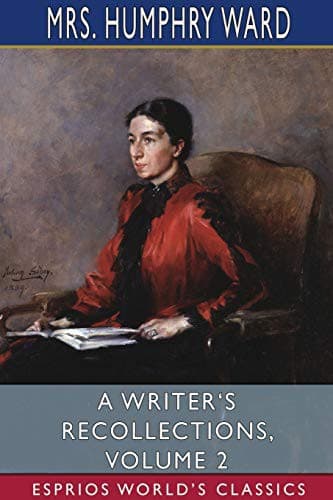
A Writer's Recollections — Volume 2Ward, Humphry, Mrs.
General
A Writer's Recollections — Volume 2
Ward, Humphry, Mrs.
Novelists, English -- 19th century -- Biography; Novelists, English -- 20th century -- Biography; Ward, Humphry, Mrs., 1851-1920
The whole thing is delicate and distinguished [he wrote me] and the
reader has the pleasure and security of feeling that he is with a
woman (distinctly a woman!) who knows how (rare bird!) to write. I
think your idea, your situation, interesting in a high degree--But
[and then come a series of most convincing "buts"! He objects
strongly to the happy ending]. I wish that your actress had been
carried away from Kendal [her critical lover, who worships herself,
but despises her art] altogether, carried away by the current of her
artistic life, the sudden growth of her power, and the excitement,
the ferocity and egotism (those of the artist realizing success, I
mean; I allude merely to the normal dose of those elements) which
the effort to create, to "arrive" (once she had had a glimpse of her
possible successes) would have brought with it. (Excuse that
abominable sentence.) Isabel, the Isabel you describe, has too much
to spare for Kendal--Kendal being what he is; and one doesn't feel
her, see her, enough, as the pushing actress, the _cabotine_! She
lapses toward him as if she were a failure, whereas you make her out
a great success. No!--she wouldn't have thought so much of him at
such a time as that--though very possibly she would have come back
to him later.
The whole letter, indeed, is full of admirable criticism, sprung from a
knowledge of life, which seemed to me, his junior by twelve years,
unapproachably rich and full. But how grateful I was to him for the
criticism!--how gracious and chivalrous was his whole attitude toward
the writer and the book! Indeed, as I look over the bundle of letters
which concern this first novel of mine, I am struck by the good fortune
which brought me such mingled chastening and praise, in such long
letters, from judges so generous and competent. Henry James, Walter
Pater, John Morley, "Mr. Creighton" (then Emmanuel Professor at
Cambridge), Cotter Morrison, Sir Henry Taylor, Edmond Scherer--they are
all there. Besides the renewal of the old throb of pleasure as one reads
them, one feels a sort of belated remorse that so much trouble was taken
for so slight a cause! Are there similar friends nowadays to help the
first steps of a writer? Or is there no leisure left in this choked
life of ours?
The decisive criticism, perhaps, of all, is that of Mr. Creighton: "I
find myself carried away by the delicate feeling with which the
development of character is traced." But--"You wrote this book as a
critic not as a creator. It is a sketch of the possible worth of
criticism in an unregenerate world. This was worth doing once; but if
you are going on with novels you must throw criticism overboard and let
yourself go, as a partner of common joys, common sorrows, and common
perplexities. There--I have told you what I think, just as I think it."
* * * * *
Public-domain text, read in full here on John Shaqi.
Reviews
Reviews
No reviews yet
Be the first to share your thoughts on this work.
Join the Discussion
Join the discussion
Sign in to leave a comment or review.
Sign InorCreate an account