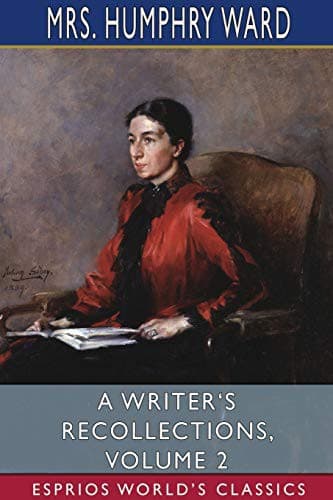
A Writer's Recollections — Volume 2Ward, Humphry, Mrs.
General
A Writer's Recollections — Volume 2
Ward, Humphry, Mrs.
Novelists, English -- 19th century -- Biography; Novelists, English -- 20th century -- Biography; Ward, Humphry, Mrs., 1851-1920
organism is still weak, but it lives. And the forces behind it are,
indefinitely, mysteriously stronger than its adversaries think."
In this mood it was that, when the book came out in the autumn of 1900,
I prefixed to it the dedication--"To Italy, the beloved and beautiful,
Instructress of our past, Delight of our present, Comrade of our future,
the heart of an Englishwoman offers this book."
"_Comrade of our future_." As one looks out to-day upon the Italian
fighting-line, where English troops are interwoven with those of Italy
and France for the defense of the Lombard and Venetian plain against the
attack of Italy's old and bitter enemy, an attack in which are concerned
not only the fortunes of Italy, but those also of the British Empire, I
wonder what touch of prophecy, what whisper from a far-off day,
suggested these words written eighteen years ago?
EPILOGUE
And here, for a time at least, I bring these _Recollections_ to an
end with the century in which I was born, and my own fiftieth year.
Since _Eleanor_ appeared, and my father died, eighteen years have
gone--years for me of constant work, literary and other. On the one
hand, increasing interest in and preoccupation with politics, owing to
personal links and friendships, and a life spent, as to half the year,
in London, have been reflected in my books; and on the other, the
English rural scene, with its country houses and villages, its religion,
and its elements of change and revolution, has been always at my home
gates, as a perpetually interesting subject. Old historic situations,
also, have come to life for me again in new surroundings, as in _Lady
Rose's Daughter_, _The Marriage of William Ashe_, and _Fenwick's
Career;_ in _Richard Meynell_ I attempted the vision of a Church
of England recreated from within, with a rebel, and not--as in
_Robert Elsmere_--an exile, for a hero; _Lady Connie_ is a picture
of Oxford as I saw her in my youth, as faithful as I can now
make it; _Eltham House_ is a return to the method of _William
Ashe_, and both _Lady Connie_ and _Missing_ have been written
since the war. _Missing_ takes for its subject a fragment
from the edge of that vast upheaval which no novel of real life
in future will be able to leave out of its ken. In the first two years
of the war, the cry both of writers and public--so far as the literature
of imagination was concerned--tended to be--"anything but the war"!
There was an eager wish in both, for a time, in the first onrush of the
great catastrophe, to escape from it and the newspapers, into the world
behind it. That world looks to us now as the Elysian fields looked to
Aeneas as he approached them from the heights--full not only of souls in
a blessed calm, but of those also who had yet to make their way into
existence as it terribly _is_, had still to taste reality and pain.
We were thankful, for a time, to go back to that kind, unconscious,
unforeseeing world. But it is no longer possible. The war has become our
Public-domain text, read in full here on John Shaqi.
Reviews
Reviews
No reviews yet
Be the first to share your thoughts on this work.
Elsewhere in the archive
Join the Discussion
Join the discussion
Sign in to leave a comment or review.
Sign InorCreate an account