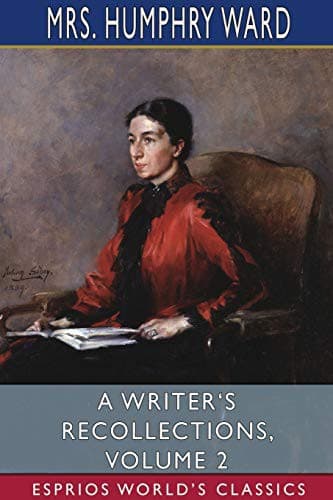
A Writer's Recollections — Volume 2Ward, Humphry, Mrs.
General
A Writer's Recollections — Volume 2
Ward, Humphry, Mrs.
Novelists, English -- 19th century -- Biography; Novelists, English -- 20th century -- Biography; Ward, Humphry, Mrs., 1851-1920
life, and will be so for years after the signing of peace.
As to the three main interests, outside my home life, which, as I look
back upon half a century, seem to have held sway over my
thoughts--contemporary literature, religious development, and social
experiment--one is tempted to say a few last summarizing things, though,
amid the noise of war, it is hard to say them with any real detachment
of mind.
When we came up to London in 1881, George Eliot was just dead (December,
1880); Browning and Carlyle passed away in the course of the 'eighties;
Tennyson in 1892. I saw the Tennyson funeral in the Abbey, and remember
it vividly. The burying of Mr. Gladstone was more stately; this of
Tennyson, as befitted a poet, had a more intimate beauty. A great
multitude filled the Abbey, and the rendering, in Sir Frederick Bridge's
setting, of "Crossing the Bar" by the Abbey Choir sent the "wild echoes"
of the dead man's verse flying up and on through the great arches
overhead with a dramatic effect not to be forgotten. Yet the fame of the
poet was waning when he died, and has been hotly disputed since; though,
as it seems to me, these later years have seen the partial return of an
ebbing tide. What was merely didactic in Tennyson is dead years ago; the
difficulties of faith and philosophy, with which his own mind had
wrestled, were, long before his death, swallowed up in others far more
vital, to which his various optimisms, for all the grace in which he
clothed them, had no key, or suggestion of a key, to offer. The
"Idylls," so popular in their day, and almost all, indeed, of the
narrative and dramatic work, no longer answer to the needs of a
generation that has learned from younger singers and thinkers a more
restless method, a more poignant and discontented thought. A literary
world fed on Meredith and Henry James, on Ibsen or Bernard Shaw or
Anatole France, or Synge or Yeats, rebels against the versified
argument, however musical or skilful, built up in "In Memoriam," and
makes mock of what it conceives to be the false history and weak
sentiment of the "Idylls." All this, of course, is true, and has been
said a thousand times, but--and here again the broad verdict is
emerging--it does not touch the lyrical fame of a supreme lyrical poet.
It may be that one small volume will ultimately contain all that is
really immortal in Tennyson's work. But that volume, it seems to me,
will be safe among the golden books of our literature, cherished alike
by young lovers and the "drooping old."
Public-domain text, read in full here on John Shaqi.
Reviews
Reviews
No reviews yet
Be the first to share your thoughts on this work.
Elsewhere in the archive
Join the Discussion
Join the discussion
Sign in to leave a comment or review.
Sign InorCreate an account