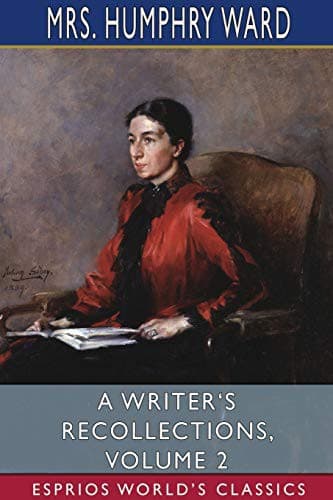
A Writer's Recollections — Volume 2Ward, Humphry, Mrs.
General
A Writer's Recollections — Volume 2
Ward, Humphry, Mrs.
Novelists, English -- 19th century -- Biography; Novelists, English -- 20th century -- Biography; Ward, Humphry, Mrs., 1851-1920
As to the social scene, let me gather from it first a recollection of
pure romance. One night at a London dinner-party I found myself sent
down with a very stout gentleman, an American Colonel, who proclaimed
himself an "esoteric Buddhist," and provoked in me a rapid and vehement
dislike. I turned my back upon him and examined the table. Suddenly I
became aware of a figure opposite to me, the figure of a young girl who
seemed to me one of the most ravishing creatures I had ever seen. She
was very small, and exquisitely made. Her beautiful head, with its mass
of light-brown hair; the small features and delicate neck; the clear,
pale skin, the lovely eyes with rather heavy lids, which gave a slight
look of melancholy to the face; the grace and fire of every movement
when she talked; the dreamy silence into which she sometimes fell,
without a trace of awkwardness or shyness. But how vain is any mere
catalogue to convey the charm of Laura Tennant--the first Mrs. Alfred
Lyttelton--to those who never saw her!
I asked to be introduced to her as soon as we left the dining-room, and
we spent the evening in a corner together.
I fell in love with her there and then. The rare glimpses of her that
her busy life and mine allowed made one of my chief joys thenceforward,
and her early death was to me--as to so many, many others!--a grief
never forgotten.
The recent biography of Alfred Lyttelton--War Minister in Mr. Balfour's
latest Cabinet--skilfully and beautifully done by his second wife, has
conveyed to the public of thirty years later some idea of Laura's
imperishable charm. And I greatly hope that it may be followed some day
by a collection of her letters, for there are many in existence, and,
young as she was, they would, I believe, throw much light upon a crowded
moment in our national life. Laura was the fourth daughter of Sir
Charles Tennant, a rich Glasgow manufacturer, and the elder sister of
Mrs. Asquith. She and her sisters came upon the scene in the early
'eighties; and without any other extrinsic advantage but that of wealth,
which in this particular case would not have taken them very far, they
made a conquest--the younger two, Laura and Margot, in particular--of a
group of men and women who formed a kind of intellectual and social
_élite_; who were all of them accomplished; possessed, almost all of
them, of conspicuous good looks, or of the charm that counts as much;
and among whom there happened to be a remarkable proportion of men who
have since made their mark on English history. My generation knew them
as "The Souls." "The Souls" were envied, mocked at, caricatured, by
those who were not of them. They had their follies--why not? They were
young, and it was their golden day. Their dislike of convention and
routine had the effect on many--and those not fools--of making
convention and routine seem particularly desirable. But there was not, I
think, a young man or woman admitted to their inner ranks who did not
Public-domain text, read in full here on John Shaqi.
Reviews
Reviews
No reviews yet
Be the first to share your thoughts on this work.
Join the Discussion
Join the discussion
Sign in to leave a comment or review.
Sign InorCreate an account