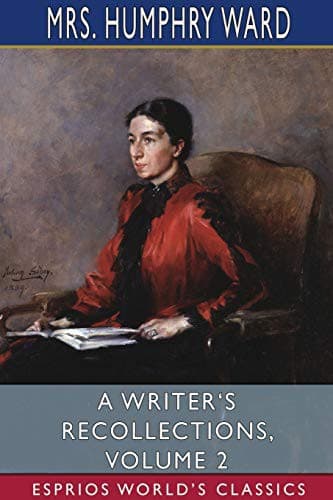
A Writer's Recollections — Volume 2Ward, Humphry, Mrs.
General
A Writer's Recollections — Volume 2
Ward, Humphry, Mrs.
Novelists, English -- 19th century -- Biography; Novelists, English -- 20th century -- Biography; Ward, Humphry, Mrs., 1851-1920
He was then a member of the Fourth Party, and engaged--though in a
rather detached fashion--in those endless raids and excursions against the
"Goats"--i.e., the bearded veterans of his own party, Sir Stafford
Northcote in particular, of which Lord Randolph was the leader. But
compared to Lord Randolph he had made no Parliamentary mark. One thought
of him as the metaphysician, the lover of music, the delightful
companion, always, I feel now, in looking back, with a prevailing
consciousness of something reserved and potential in him, which gave a
peculiar importance and value to his judgments of men and things. He was
a leading figure among "The Souls," and I remember some delightful
evenings in his company before 1886, when the conversation was entirely
literary or musical.
Then, with the Chief-Secretaryship there appeared a new Arthur Balfour.
The courage, the resource, the never-failing wit and mastery with which
he fought the Irish members in Parliament, put down outrage in Ireland,
and at the same time laid the foundation in a hundred directions of that
social and agrarian redemption of Ireland on which a new political
structure will some day be reared--is perhaps even now about to
rise--these things make one of the most brilliant, one of the most
dramatic, chapters in our modern history.
[Illustration: ARTHUR JAMES BALFOUR]
It was in 1888, two years after Mr. Forster's death, that we found
ourselves for a Sunday at Whittinghame. It was, I think, not long before
the opening of the Special Commission which was to inquire into the
charges brought by the _Times_ against the Parnellites and the Land
League. Nothing struck me more in Mr. Balfour than the absence in him of
any sort of excitement or agitation, in dealing with the current charges
against the Irishmen. It seemed to me that he had quietly accepted the
fact that he was fighting a revolution, and, while perfectly clear as to
his own course of action, wasted no nervous force on moral reprobation
of the persons concerned. His business was to protect the helpless, to
punish crime, and to expose the authors of it, whether high or low. But
he took it as a job to be done--difficult--unpleasant--but all in the
way of business. The tragic or pathetic emotion that so many people were
ready to spend upon it he steadily kept at a distance. His nerve struck
me as astonishing, and the absence of any disabling worry about things
past. "One can only do one's best at the moment," he said to me once, _à
propos_ of some action of the Irish government which had turned out
badly--"if it doesn't succeed, better luck next time! Nothing to be
gained by going back upon things." After this visit to Whittinghame, I
wrote to my father:
Public-domain text, read in full here on John Shaqi.
Reviews
Reviews
No reviews yet
Be the first to share your thoughts on this work.
Join the Discussion
Join the discussion
Sign in to leave a comment or review.
Sign InorCreate an account